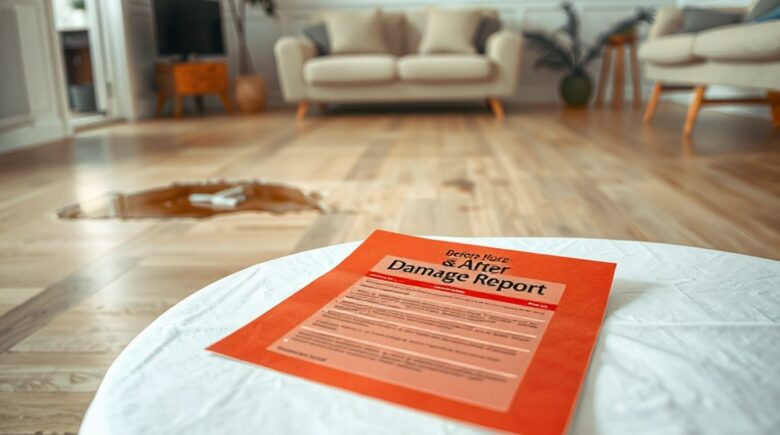
Quick Answer
Start documenting home damage for insurance claims by snapping clear photos and videos ASAP, within that crucial 48-hour window after an incident, before any clean-up begins. We’re talking wide-angle shots to show the full extent of damage, in-and-out-of close-ups on specific issues, and don’t forget those appliance serial numbers. A recent 2023 survey by Triple-I and Munich Re found that a whopping 47% of homeowners who got this inventory prep right were fully reimbursed for their stuff.
The following is part of our jam-packed guide: The Nitty-Gritty Homeowners Insurance Claims Process Explained. Right here, we’re diving deep into a crucial phase: nailing down damage docs before and after filing that claim. It’s not just helpful; it often makes or breaks your settlement.
Mind-blowing fact: In 2023 alone, 5.3% of insured homes filed a claim. And get this, nearly half – 42%, according to LexisNexis’ 2024 report – were weather-related nightmares like storms, fires, or floods. These big-ticket claims are under a microscope. One little slip-up in your docs could derail an otherwise solid claim. Your best bet? Build that rock-solid paper trail from day one.
SoFi’s 2024 financial wellness report revealed something interesting – 68% of homeowners who played their cards right with documented proof of loss saw their claims wrapped up quicker. But hey, even the best docs can’t guarantee a win every time. About a quarter of claims still get denied or snipped due to evidence gaps.
Key Takeaways
- 47% of homeowners who whipped up an inventory got their stuff fully reimbursed, say Triple-I and Munich Re’s 2023 Consumer Survey.
- 5.3% of insured homes filed a claim in 2023, with 42% being catastrophe-related, thanks to LexisNexis Risk Solutions’ 2024 report.
- Time’s a-tickin’: Texas and Idaho state insurance departments urge homeowners to snap pics within 24-48 hours to dodge claim denials.
- Maintain metadata and use secure cloud backups. Some insurers might call ‘foul’ if files lack this info or were uploaded via sketchy channels.
- Here’s the kicker: Even with airtight docs, insurers could still deny claims based on policy nitty-gritties or procedural hiccups.
| Claim Type | Average Payout (2023) | Claim Denial Rate (2025) |
|---|---|---|
| Catastrophe (storm, fire, flood) | $20,062 | At least 50% |
| Non-catastrophe (e.g., water leak, theft) | $12,470 | 45% (estimated) |
Why Documenting Damage Determines Claim Outcomes
Insurers run on evidence. A photo taken three weeks after a storm doesn’t show original conditions. A video without a timestamp can’t prove when the ceiling caved in. According to Weiss Ratings’ 2025 report, at least 50% of claims from 15 major U.S. insurers were closed with no payment at all.
FEMA advises homeowners to capture damage from multiple angles before discarding anything. That applies to the structure itself and to personal possessions scattered across the floor. Insurance Information Institute data confirms it: 47% of homeowners who kept an active inventory were fully reimbursed in their 2023 survey.
Consider what happened to one Austin, Texas claimant. Their $12,000 water damage claim was cut by 30% because the photos lacked clear timestamps and the carpet had already been removed by the time an adjuster arrived. The adjuster flagged it as “incomplete evidence” and reduced the payout accordingly.
Creating a Pre-Loss Home Inventory That Actually Holds Up
Most homeowners don’t bother. The ones who do are twice as likely to receive full payment when a claim comes in.
Start with a room-by-room video walkthrough using your smartphone. Move slowly. Point the camera at cabinets, shelves, wall fixtures, and every piece of electronics you own. Read serial numbers aloud. Idaho’s Department of Insurance puts it plainly: “Take photos or video to record initial damages before any damage mitigation.” Skipping this step has cost claimants thousands.
Back everything up to Google Drive or Dropbox, or at minimum a password-protected folder on a second device. A Boise homeowner learned this the hard way after her phone was stolen during a burglary. Her entire pre-loss inventory vanished with it, and the claim was denied.
Revisit the inventory once a year. Add new purchases. Remove items you’ve sold or donated. Use Sortly or Google Keep to stay organized. And be specific: not “living room TV” but “Sony Bravia X90J 65-inch, serial #23456789.” That kind of precision is exactly what adjusters look for when deciding whether to pay in full.
First 48 Hours: Documenting Damage After a Loss
The clock starts the moment damage occurs. Don’t wait.
As soon as the area is safe, start shooting photos and video. Both the Texas and Alabama insurance departments require prompt documentation. FEMA is direct about it: “Take photos and videos of the damage before discarding items.” The Federal Reserve’s 2024 Consumer Financial Protection Survey found that 61% of claimants who acted within 48 hours received faster settlements than those who held off.
Don’t clean, dry, or remove anything yet. Soggy carpet, cracked tiles, collapsed beams, all of it stays put until it’s documented. If you have to make a temporary fix, say covering a roof hole with a tarp, photograph the damage first, then photograph the repair. That sequence protects you from any suggestion that you concealed the original problem.
One Birmingham, Alabama homeowner had their $8,200 storm claim denied after repairing the roof before submitting evidence. This happened despite having a claim form already signed by their Allstate broker.

Capturing Effective Photos and Videos
Not all photos hold equal weight with adjusters. The ones that work best show context, timing, and specifics.
Begin with wide-angle shots of the entire room. Then move closer: the water stain spreading across the ceiling, the crack running through the floor tile, the doorframe that’s warped and won’t close. Natural light beats flash. Flash tends to wash out surface texture and shadow detail that adjusters use to assess severity. If flash is unavoidable, turn off auto-brightness first.
Timestamps matter enormously. Most smartphones embed them automatically in the file metadata. If yours doesn’t, hold a clock or watch in frame. Don’t edit the photos afterward. Some carriers, including State Farm and Farmers, have flagged claims where image metadata had been stripped, treating it as a red flag. Use FloodSmart.gov’s guide to preserve metadata and upload files securely.