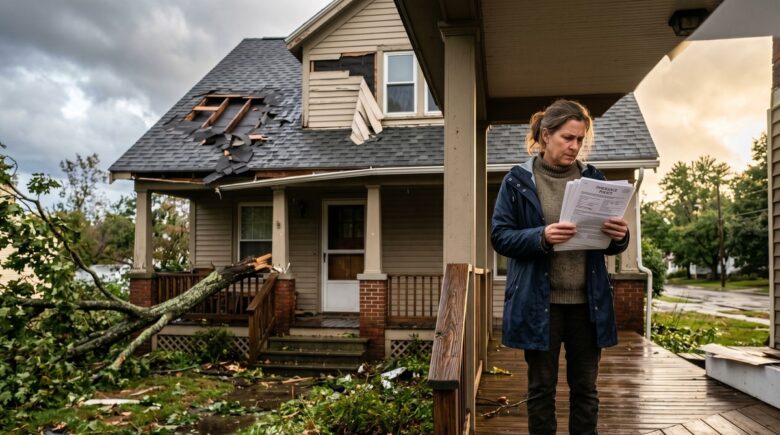
Fact-checked by the The Insurance Scout editorial team
Quick Answer
Standard homeowners insurance covers wind, hail, fire, and lightning damage from natural disasters — but it excludes floods and earthquakes entirely, which require separate policies. As of July 2025, the average homeowner pays $2,285 per year for coverage that protects against some disasters but quietly omits the two most financially devastating ones. Read your declarations page, then add riders as needed.
Understanding what your homeowners insurance natural disaster coverage actually includes — and excludes — could be the difference between a full recovery and financial ruin. According to the Insurance Information Institute, insured losses from natural catastrophes in the United States exceeded $100 billion in recent years, yet millions of homeowners file claims only to discover their policy doesn’t cover the disaster they just survived. This guide was updated in July 2025 to reflect current policy standards and coverage gaps.
Climate change is reshaping the risk landscape faster than most insurance policies are keeping pace. The Federal Emergency Management Agency reports that 1 in 4 flood insurance claims come from properties outside high-risk flood zones — meaning homeowners who assumed they were safe are being blindsided. Premium increases, new exclusions, and insurer pullouts in wildfire and hurricane states have made policy literacy more urgent than ever.
This guide is for homeowners at any stage — whether you’re buying your first home, reviewing an existing policy after a close call, or trying to understand a denied claim. By the end, you’ll know exactly which disasters your standard policy covers, which ones it silently excludes, and the precise steps to plug those gaps before the next storm hits.
Key Takeaways
- Standard homeowners insurance covers 16 named perils under an HO-3 policy, including wind, hail, fire, and lightning — but not floods or earthquakes, according to the Insurance Information Institute.
- Flood damage is the most common and costly natural disaster in the U.S., causing an average of $4.6 billion in annual losses, per FEMA’s National Flood Insurance Program data.
- Only about 12% of homeowners carry a separate flood insurance policy, leaving the vast majority exposed to a risk their standard policy won’t touch, according to III flood insurance statistics.
- Earthquake coverage requires a standalone policy or endorsement; in California alone, only 13% of homeowners have earthquake insurance, per the California Earthquake Authority.
- Hurricane wind damage is typically covered, but separate hurricane deductibles — often 2%–5% of your home’s insured value — apply in 19 coastal states, according to III hurricane deductible data.
- Adding flood and earthquake coverage can cost as little as $700–$900 combined per year for most inland homeowners, making the protection highly cost-effective relative to the average flood claim of $52,000, per FEMA claims data.
In This Guide
- What Does Homeowners Insurance Actually Cover During a Natural Disaster?
- What Natural Disasters Are NOT Covered by Standard Homeowners Insurance?
- Do I Need Separate Flood Insurance Even If I’m Not in a Flood Zone?
- How Does Homeowners Insurance Handle Hurricanes, Wildfires, and Tornadoes?
- How Do I Fill the Coverage Gaps in My Homeowners Insurance Policy?
- How Do I File a Homeowners Insurance Claim After a Natural Disaster?
- Frequently Asked Questions
Step 1: What Does Homeowners Insurance Actually Cover During a Natural Disaster?
A standard HO-3 homeowners insurance policy covers your dwelling, personal property, and additional living expenses when damage is caused by a list of named perils — and several of those perils are natural disasters. The key covered events include wind, hail, lightning, fire, volcanic eruption, and the weight of ice or snow.
How to Identify What Your Policy Covers
Pull out your declarations page (the summary sheet at the front of your policy) and look for Section I — Property Coverages. Your policy will either list covered perils explicitly or state “open perils,” meaning all causes are covered except those specifically excluded. Most HO-3 policies use a hybrid: open perils for the dwelling structure, named perils for personal property.
The four standard coverage components relevant to natural disasters are:
- Coverage A (Dwelling): Pays to repair or rebuild your home’s structure.
- Coverage B (Other Structures): Covers detached garages, fences, and sheds.
- Coverage C (Personal Property): Reimburses belongings damaged by a covered peril.
- Coverage D (Loss of Use / ALE): Pays hotel and living costs if your home becomes uninhabitable.
For a deeper look at how coverage types compare and what each actually pays out, see our guide on Actual Cash Value vs Replacement Cost coverage — because the payout method matters as much as whether the disaster is covered at all.
What to Watch Out For
Coverage A pays based on your dwelling replacement cost, not the market value of your home. If you under-insure your home — which is common after renovations — you may face a significant shortfall. Our article on how a home renovation affects your homeowners insurance explains why you must update your coverage limits after major improvements.
Volcanic eruption is one of the few exotic natural disasters explicitly covered by most standard HO-3 policies. Lava flow that directly destroys your home is typically covered — but flooding caused by volcanic activity (such as lava-dammed rivers overflowing) is not, because the resulting damage is categorized as flood.
Step 2: What Natural Disasters Are NOT Covered by Standard Homeowners Insurance?
The two largest gaps in standard homeowners insurance natural disaster coverage are floods and earthquakes — both of which are explicitly excluded in virtually every HO-3 policy issued in the United States. These are not fine-print surprises; they are categorical exclusions that require entirely separate policies.
The Major Exclusions, Explained
Flood damage is excluded because it is defined as water rising from the ground up — including storm surges, overflowing rivers, and heavy-rain runoff. Even if a hurricane causes the flooding, if water enters your home from the ground rather than from wind-driven rain, your standard policy will not pay.
Earthquake damage is excluded due to the catastrophic, concentrated nature of seismic events. Insurers cannot spread earthquake risk the same way they spread wind risk, so they price and sell it separately. This exclusion applies nationwide — not just in California or Alaska.
Additional common exclusions include:
- Sinkholes: Excluded in most states except Florida, where separate sinkhole coverage is often required.
- Landslides and mudslides: Classified as “earth movement,” these are excluded alongside earthquakes.
- Tsunamis: Excluded as a combination of earthquake and flood — neither of which is covered.
- Sewer backup: Not covered unless you add a specific endorsement, even if caused by a storm event.
“The biggest misconception homeowners have is that their policy covers all natural disasters. In reality, standard policies are designed around fire and wind risk. Flood and earthquake are treated as entirely separate insurance markets for actuarial reasons that date back decades.”
To understand the full scope of what your policy won’t cover, it also helps to read about named perils vs open perils coverage — the distinction directly determines which disasters trigger a payout.
What to Watch Out For
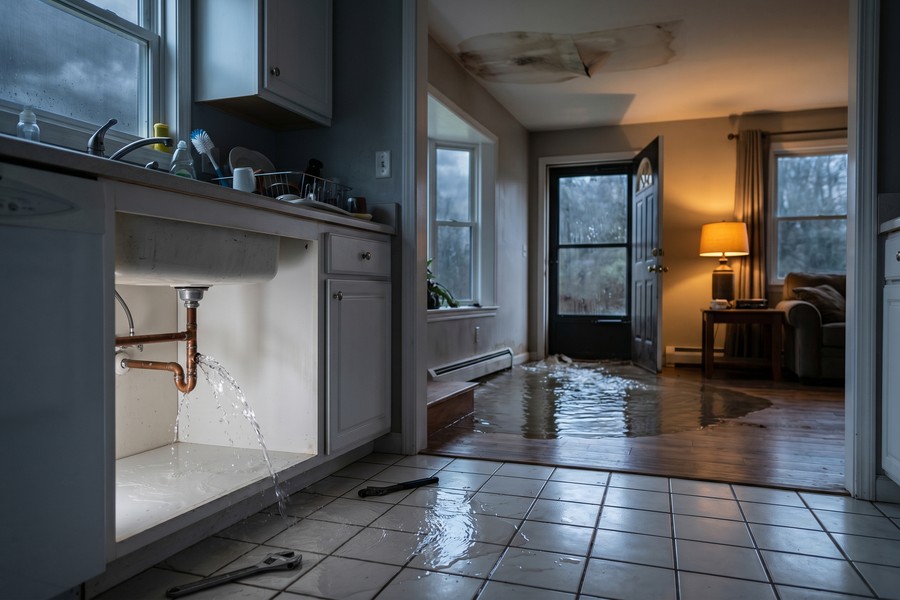
Many homeowners confuse “water damage” with “flood damage.” A burst pipe that causes interior water damage is typically covered. Rainwater that enters through a wind-damaged roof is typically covered. But any water that originates from the ground or an overflowing body of water is flood damage — and excluded.
Some insurers use the term “surface water intrusion” to describe water that enters your home from rain pooling against your foundation. This is categorized as flood damage and excluded — even if it has never flooded in your area before. Do not assume proximity to a floodplain is what triggers the exclusion.
Step 3: Do I Need Separate Flood Insurance Even If I’m Not in a Flood Zone?
Yes — the majority of flood insurance claims, roughly 25%, come from properties outside high-risk FEMA flood zones, which means being in a “low-risk” area does not eliminate your exposure. Flood insurance is worth considering for virtually every homeowner, not just those in coastal or riverside locations.
How to Get Flood Insurance
There are two primary ways to purchase flood coverage:
- FEMA’s National Flood Insurance Program (NFIP): Available to homeowners in participating communities. As of 2025, NFIP policies cover up to $250,000 for your dwelling and $100,000 for personal property. Premiums under the updated Risk Rating 2.0 system average around $888 per year nationally, according to FEMA’s Risk Rating 2.0 data.
- Private flood insurance: Available through insurers like Neptune Flood, Palomar, and others. These policies can offer higher coverage limits, shorter waiting periods (sometimes 24–48 hours vs. the NFIP’s standard 30-day wait), and broader definitions of flood.
Note the 30-day waiting period on most NFIP policies. If a named storm is approaching and you don’t have flood insurance yet, it is too late to purchase it and have it active before the storm hits.
What to Watch Out For
NFIP coverage does not include Additional Living Expenses (ALE). If your home floods and you need to live in a hotel for three months, the NFIP will not pay those costs. Private flood policies often do include ALE, which is one reason they can be worth the premium difference.
The average NFIP flood claim payout is $52,000, according to FEMA — enough to understand why the average annual premium of $888 represents an extraordinary value for at-risk homeowners. Yet fewer than 12% of U.S. homeowners carry any flood coverage at all.
| Coverage Feature | NFIP Flood Policy | Private Flood Insurance | Standard HO-3 Policy |
|---|---|---|---|
| Flood Damage Covered | Yes | Yes | No |
| Dwelling Coverage Limit | Up to $250,000 | Up to $5,000,000+ | Based on rebuild cost |
| Personal Property Limit | Up to $100,000 | Varies, often higher | 50–70% of dwelling limit |
| Additional Living Expenses | Not covered | Usually included | Included for covered perils |
| Waiting Period | 30 days | 24–48 hours (typical) | Immediate |
| Average Annual Premium | ~$888/year | $500–$2,000+/year | $2,285/year (all-in) |
| Basement Contents | Severely limited | Often included | Not covered for flood |
Step 4: How Does Homeowners Insurance Handle Hurricanes, Wildfires, and Tornadoes?
Hurricanes, wildfires, and tornadoes are covered by standard homeowners insurance — but each comes with important carve-outs and special deductible rules that can dramatically reduce your actual payout. Understanding these nuances before a disaster is critical.
Hurricanes
Your HO-3 policy covers wind damage from a hurricane, including damage to your roof, windows, and siding. However, 19 coastal states and the District of Columbia allow insurers to apply a separate hurricane or windstorm deductible that is calculated as a percentage of your home’s insured value — typically 1%–5% — rather than a flat dollar amount, according to III hurricane deductible data.
On a home insured for $400,000, a 5% hurricane deductible means you pay the first $20,000 out of pocket before your insurer covers anything. This catches many homeowners completely off guard after a major storm.
Storm surge — the wall of ocean water pushed inland by hurricane winds — is treated as flood damage and is not covered by your standard policy. This was a major issue after Hurricane Katrina and Hurricane Ian, where storm surge caused the majority of structural damage but was excluded from standard claims.
Wildfires
Fire is one of the oldest covered perils in property insurance, and wildfire damage is covered under standard HO-3 policies. However, insurers are now pulling out of high-risk wildfire states at an accelerating pace. In California, major carriers including State Farm, Allstate, and Farmers have paused or restricted new homeowners policies in high-fire-risk ZIP codes. Affected homeowners may be forced into the California FAIR Plan, a last-resort insurer with limited coverage that tops out at $3 million per property as of 2025.
Tornadoes
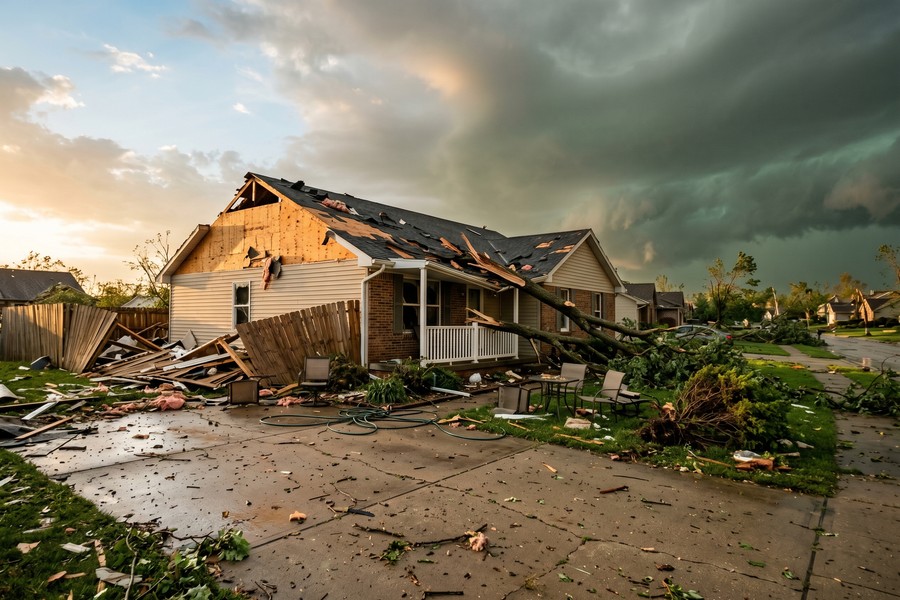
Tornado damage is covered as wind damage under a standard HO-3 policy. There is generally no separate tornado deductible in most states, though some insurers in Tornado Alley states (Oklahoma, Kansas, Texas, Nebraska) apply a windstorm deductible similar to hurricane deductibles. Your ALE coverage will pay for hotel stays and temporary housing while tornado repairs are completed.
Check your declarations page specifically for the phrase “hurricane deductible” or “windstorm deductible.” Many homeowners in coastal states don’t realize a separate, percentage-based deductible applies until they file a claim. Ask your agent to walk you through the exact trigger conditions — some policies only activate the hurricane deductible when the storm reaches a certain category or wind speed.
Step 5: How Do I Fill the Coverage Gaps in My Homeowners Insurance Policy?
Filling your homeowners insurance natural disaster coverage gaps requires a targeted approach: identify your specific regional risks, then add the corresponding endorsements or standalone policies. This process takes less than a few hours but can prevent a six-figure shortfall.
How to Do This
Step 1: Map your local hazards. Use FEMA’s Flood Map Service Center to check your property’s flood zone designation. Check the USGS Earthquake Hazards Program for seismic risk. Review your state’s wildfire risk maps if you live in the western U.S.
Step 2: Add flood coverage. Contact your current insurance agent to ask about NFIP policies. Compare their quote with private flood insurers like Neptune Flood, Palomar Specialty, or Wright Flood. Buy before storm season starts — remember the 30-day NFIP waiting period.
Step 3: Add earthquake coverage. In California, purchase through the California Earthquake Authority (CEA). In other states, ask your insurer about an earthquake endorsement or standalone policy. The average earthquake insurance premium ranges from $800–$5,000 per year depending on location, home age, and construction type.
Step 4: Consider a sewer backup endorsement. This typically costs only $40–$100 per year and covers one of the most common water damage events after heavy rain.
Step 5: Review your Coverage D limits. Your additional living expenses coverage should be high enough to cover at least 12 months of alternative housing in your area. In expensive metros, the default ALE limit may be insufficient.
What to Watch Out For
Do not assume an endorsement on your existing policy provides the same coverage as a standalone policy. Some earthquake endorsements have very narrow triggers or apply high deductibles — often 10%–20% of the dwelling coverage — that render them less useful than they appear.
If you have made significant upgrades to your home, your current dwelling coverage limit may be outdated. Review our guide on how home renovations affect your homeowners insurance to ensure your rebuild cost is accurate before adding supplemental policies.
Bundle your flood and earthquake review with your annual homeowners insurance renewal. Insurers often discount supplemental coverage when it is added alongside a renewed HO-3 policy, and it is the easiest time to compare your dwelling replacement cost against current construction costs in your area.
Step 6: How Do I File a Homeowners Insurance Claim After a Natural Disaster?
Filing a claim after a natural disaster requires speed, documentation, and careful sequencing — especially when multiple policies (homeowners, flood, earthquake) may apply to the same event. Missteps in the filing process are among the most common reasons claims are reduced or denied.
How to Do This
1. Document everything immediately. Photograph and video every damaged area before making any repairs. This evidence is the foundation of your entire claim. Use a timestamped camera app or upload directly to a cloud service to establish date and time.
2. Make emergency repairs only. Your policy requires you to prevent further damage — covering a damaged roof with a tarp, for example. But do not make permanent repairs before your adjuster inspects. Keep every receipt for emergency materials, as these costs are reimbursable.
3. File separate claims for separate policies. If you have both a homeowners policy and a flood policy, file with both. Do not assume one claim will cover everything. Flood adjusters and homeowners adjusters are different people and may visit separately.
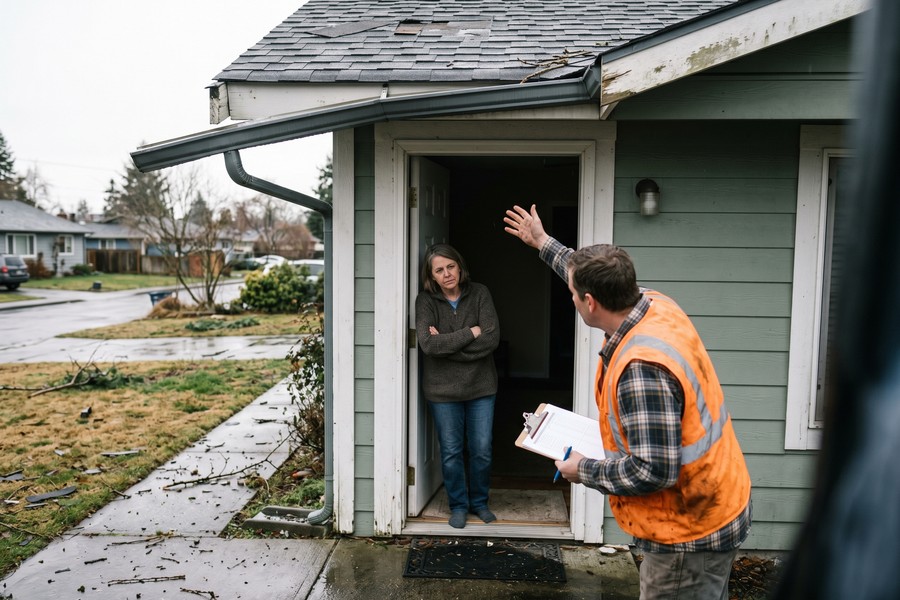
4. Request a written scope of loss. After the adjuster’s inspection, ask for a written itemized estimate of what they plan to pay. Compare this to your own contractor estimates before accepting any settlement offer.
5. Know your right to a public adjuster. If the settlement offer seems low, you can hire a licensed public adjuster — an independent professional who works for you, not the insurer. They typically charge 10%–15% of the final settlement but often recover significantly more than the insurer’s initial offer.
Avoiding common mistakes during this process is critical. Review the five homeowners insurance mistakes that lead to denied claims before you file — several of them are directly relevant to disaster scenarios.
What to Watch Out For
Natural disasters often trigger a surge in contractor fraud. Be cautious of unsolicited contractors who appear at your door after a storm offering to “work directly with your insurance company.” Always verify licensing, check references, and get multiple bids before signing any contract.
“After a major disaster, insurers are handling thousands of claims simultaneously. Homeowners who have a complete inventory, photographs, and a professional estimate ready at the time of the adjuster’s visit consistently receive faster and more complete settlements than those who don’t.”
Most homeowners policies have a claims filing deadline — often one year from the date of loss, though some states impose shorter windows. In a disaster zone, it is easy to delay filing while managing more immediate priorities. Missing the deadline can forfeit your right to any recovery, even for clearly covered damage.
Frequently Asked Questions
Does homeowners insurance cover storm surge from a hurricane?
No — storm surge is classified as flood damage and is excluded from standard homeowners insurance policies. Even though a hurricane causes the storm surge, the water entering your home from the ground up falls under the flood exclusion. You need a separate flood insurance policy through FEMA’s NFIP or a private flood insurer to be covered for storm surge. This distinction has resulted in billions of dollars in uncovered losses after major Atlantic hurricane seasons.
Will my homeowners insurance pay if a tornado destroys my home completely?
Yes — tornado damage is covered as a windstorm peril under a standard HO-3 policy, including complete structural destruction. Your Coverage A (Dwelling) will pay to rebuild your home up to your policy’s insured limit, which is why it is critical that your dwelling coverage reflects current construction costs. Check whether your policy includes a guaranteed replacement cost provision, which pays full rebuild costs even if they exceed your coverage limit — this is especially valuable after widespread tornado events that drive up contractor prices.
My home was damaged by a wildfire — what exactly will my insurance pay for?
A standard HO-3 policy will cover the cost to repair or rebuild your home’s structure, replacement of personal property destroyed by the fire, debris removal, and additional living expenses while your home is uninhabitable. Personal property is typically covered up to 50%–70% of your dwelling limit for named perils, and wildfire is a named peril. High-value items like jewelry, art, and electronics may be subject to sub-limits, so review your policy’s scheduled personal property provisions and consider adding floaters for high-value items.
How much does flood insurance cost and is it worth it if I’m not in a flood zone?
NFIP flood insurance averages $888 per year nationally under the Risk Rating 2.0 pricing system, though premiums vary significantly by location, elevation, and building characteristics. For homeowners outside high-risk flood zones, premiums can be as low as $400–$600 per year for preferred-risk policies. Given that the average flood claim pays out $52,000, flood insurance is widely considered one of the highest-value coverage additions available — especially since a quarter of all NFIP claims come from low-to-moderate risk areas.
Can I get earthquake insurance if I don’t live in California?
Yes — earthquake insurance is available in all 50 states, not just California. Outside California, earthquake coverage is typically added as an endorsement to your existing homeowners policy rather than purchased as a standalone policy. Premiums vary widely based on your home’s proximity to fault lines, construction type, and age of the structure. Homeowners in states like Washington, Oregon, South Carolina, Missouri, and Tennessee — all of which have significant seismic risk — should strongly consider earthquake coverage, as standard policies exclude it uniformly.
What if my homeowners insurance claim for natural disaster damage is denied — what can I do?
First, request a written explanation of the denial and identify the specific policy exclusion or clause the insurer cited. You have the right to request a re-inspection if you believe the damage assessment was incomplete. If the dispute continues, you can hire a licensed public adjuster to negotiate on your behalf, file a complaint with your state’s Department of Insurance, or pursue mediation or appraisal — many policies have a binding appraisal clause. As a last resort, a bad faith insurance attorney can evaluate whether the insurer improperly denied a valid claim. For more on avoiding denial triggers proactively, see our guide on homeowners insurance claim denied mistakes.
Does homeowners insurance cover temporary housing after a natural disaster forces me to leave?
Yes — Coverage D (Additional Living Expenses or Loss of Use) pays for hotel stays, temporary rentals, restaurant meals above your normal food budget, and other costs incurred while your home is being repaired after a covered disaster. The standard ALE limit is 20%–30% of your dwelling coverage, meaning on a $300,000 home policy, you’d have $60,000–$90,000 in temporary living coverage. Note that ALE is only triggered by covered perils — if your home is uninhabitable due to flood damage and you don’t have flood insurance, your ALE coverage will not activate for that event.
How do I know if my homeowners insurance covers natural disasters in my specific state?
The coverage fundamentals are consistent nationwide — standard HO-3 policies cover wind, fire, hail, and lightning while excluding floods and earthquakes in every state. However, state-specific rules affect deductibles, required endorsements, and available insurers. Florida requires separate windstorm coverage in many counties. Louisiana and Texas have state wind pools for coastal properties. California has the FAIR Plan for fire-risk areas. Review your policy alongside your state’s Department of Insurance website, and ask your agent specifically about state-mandated exclusions or required add-ons. For a cost baseline, see our homeowners insurance cost by state breakdown.
Should I buy homeowners insurance based on my home’s market value or rebuild cost?
Always insure based on rebuild cost, not market value. Market value includes land, which cannot be destroyed by a disaster, and it reflects local real estate conditions that have nothing to do with construction costs. Rebuild cost reflects the actual expense of labor and materials to reconstruct your home from the ground up. In many markets, the rebuild cost is significantly lower than the market value — but in others, especially post-disaster labor markets, rebuild costs can exceed what you paid for the home. Our guide on actual cash value vs replacement cost coverage explains exactly how these two valuation methods affect your payout.
Does a homeowners insurance natural disaster claim raise my rates?
Filing a natural disaster claim can raise your premium, but the increase depends on your insurer, your claims history, and whether the disaster was widespread. In many states, insurers are prohibited from raising rates or canceling policies solely because you filed a claim from a declared federal disaster. However, living in an area hit repeatedly by the same type of disaster — wildfire, flooding, hail — can result in non-renewal or surcharges at your next renewal. Document the disaster’s widespread nature when you file, as catastrophic events are often treated differently from individual claims by underwriters.
Sources
- Insurance Information Institute — Homeowners and Renters Insurance Facts and Statistics
- Insurance Information Institute — What Is Covered by Standard Homeowners Insurance?
- FEMA — National Flood Insurance Program Overview
- FEMA — Risk Rating 2.0: Equity in Action
- FEMA — Flood Map Service Center
- Insurance Information Institute — Hurricane and Windstorm Deductibles
- Insurance Information Institute — Flood Insurance Facts and Statistics
- California Earthquake Authority — Earthquake Insurance Information
- United Policyholders — Disaster Insurance Claims Guidance
- National Association of Insurance Commissioners — Homeowners Insurance Topic