Fact-checked by the The Insurance Scout editorial team
You installed a pool expecting summer fun — and got a surprise from your insurance company instead. Across the country, homeowners are discovering that adding a pool to their property can trigger premium increases of 10% to 25% or more, sometimes without any advance warning from their insurer. If you’ve recently built a pool — or you’re planning to — understanding exactly how swimming pool homeowners insurance works could save you thousands of dollars and a catastrophic liability lawsuit.
The stakes are not small. According to the Centers for Disease Control and Prevention, drowning is the leading cause of unintentional injury death for children ages 1 to 4, and residential swimming pools account for a significant share of those tragedies. Insurers know this. The Insurance Information Institute reports that personal liability claims related to pools can easily reach $100,000 to $500,000 — and some settlements climb into the millions. That exposure is why carriers treat a backyard pool the same way they treat a trampoline or a dog with a bite history: as an “attractive nuisance” that fundamentally changes your risk profile.
This guide gives you a complete, data-backed breakdown of how pools affect your homeowners insurance costs, what coverage you actually need, how to avoid common mistakes that void your policy, and the exact steps to take with your insurer before — and after — you build. Whether you’re a new pool owner or already have water in the ground, what follows will help you stay covered, stay protected, and avoid overpaying.
Key Takeaways
- A swimming pool typically increases homeowners insurance premiums by 10% to 25%, adding roughly $50 to $75 per year on average — though liability exposure can cost far more if a claim occurs.
- Standard homeowners policies include $100,000 in personal liability coverage, but pool-related injury claims routinely exceed that — experts recommend at least $300,000 to $500,000.
- An umbrella insurance policy adding $1 million in liability coverage costs as little as $150 to $300 per year — making it one of the best values in personal insurance.
- Failing to notify your insurer about a new pool can result in a denied claim or policy cancellation — some insurers require notification within 30 days of construction.
- Pool enclosures, fencing (at least 4 feet tall), pool alarms, and self-latching gates can reduce liability premiums by up to 10% with some carriers.
- The average residential pool injury lawsuit takes 12 to 36 months to resolve and the average settlement for a drowning wrongful-death claim is approximately $1.2 million to $2.5 million.
In This Guide
- What Makes a Pool an “Attractive Nuisance”
- How a Pool Changes Your Homeowners Insurance Premium
- Liability Coverage: How Much Is Actually Enough?
- Above-Ground vs. In-Ground Pools: How Pool Type Affects Your Rate
- How and When to Notify Your Insurer
- Safety Features That Lower Your Swimming Pool Homeowners Insurance Cost
- Why an Umbrella Policy Is Nearly Non-Negotiable for Pool Owners
- What Your Policy Won’t Cover
- Shopping for the Right Coverage as a Pool Owner
What Makes a Pool an “Attractive Nuisance”
The legal doctrine of attractive nuisance holds that a property owner can be held liable for injuries to trespassing children if the owner maintains a condition on the property that is likely to attract children who cannot appreciate the danger. Courts have applied this doctrine to swimming pools for decades, and it is the conceptual foundation for why insurers treat pools differently from other home improvements.
In practical terms, this means that if a neighbor’s child wanders into your unfenced yard and drowns in your pool, you may be legally liable — even though you didn’t invite anyone in. Most states recognize this doctrine explicitly, and even those that don’t tend to use similar negligence frameworks that reach the same result.
The Child Drowning Data Insurers Use to Set Rates
Drowning statistics drive underwriting decisions more than almost any other residential risk factor. The CDC reports that approximately 800 children under age 14 drown in residential pools each year in the United States. For every child who drowns, roughly five more are treated in emergency rooms for submersion injuries that can cause permanent brain damage.
Insurers model these probabilities across their entire book of business. A carrier with 50,000 policyholders who own pools knows — statistically — how many claims they will receive each year. That calculation feeds directly into your premium.
The attractive nuisance doctrine can apply even if you have a fence — if the fence has a gate that is frequently left open, courts have found that the property owner failed to exercise reasonable care.
Pools vs. Other Attractive Nuisances
Insurers rank residential hazards by their frequency and severity of claims. Pools consistently rank alongside trampolines and certain dog breeds as the highest-risk property features. The table below shows how pools compare to other common attractive nuisances in terms of typical liability impact.
| Hazard | Typical Premium Impact | Common Insurer Response |
|---|---|---|
| In-Ground Pool | +10% to +25% | Requires notification; may mandate fencing |
| Above-Ground Pool | +5% to +15% | Requires notification; ladder rules may apply |
| Trampoline | +10% to +20% | Some carriers refuse coverage entirely |
| Dog (certain breeds) | +15% to +25% | Exclusion or surcharge common |
| Diving Board | +5% to +10% additional | Many carriers require removal for coverage |
| Pool Slide | +3% to +8% additional | Varies widely by carrier |
How a Pool Changes Your Homeowners Insurance Premium
Adding a pool affects your homeowners insurance in two distinct ways: it increases your dwelling and property coverage needs because the pool itself is an asset to insure, and it dramatically increases your liability exposure. Most homeowners focus on the property side and underestimate the liability impact — which is where the real financial danger lies.
On the property side, an in-ground pool typically adds $10,000 to $40,000 in value to a home. Your insurer needs to know about this to accurately calculate replacement cost coverage. If your home is insured for $350,000 but a pool adds $35,000 in value, your coverage may be inadequate — a gap that matters enormously when a claim occurs. For more on how renovations and improvements affect your coverage limits, see our guide on how a home renovation affects your homeowners insurance.
Dollar-by-Dollar Premium Breakdown
According to industry data from the Insurance Information Institute, the average U.S. homeowners insurance premium in 2024 was approximately $1,428 per year. A 10% to 25% increase for a pool translates to $143 to $357 per year in additional premium — though the exact figure varies by carrier, state, pool type, and safety features.
Some insurers charge a flat surcharge rather than a percentage increase. Others build the cost into a broader “property risk” score. Regardless of the calculation method, the financial impact is real and recurring — you pay it every year the pool is in the ground.
The average in-ground pool costs $35,000 to $65,000 to install. The lifetime insurance premium increase — over 20 years at a $200/year surcharge — adds another $4,000 to the total cost of pool ownership.
How Insurers Calculate Pool Risk
Underwriters consider several variables when pricing pool risk. Location matters significantly — a pool in Florida, where year-round access is possible, is priced differently than one in Minnesota with a six-month swimming season. The pool’s depth, the presence of a diving board or slide, and whether it is fenced all factor into the rate calculation.
Your claims history also plays a role. If you’ve filed liability claims in the past — even unrelated to a pool — some carriers will view the addition of a pool as compounding existing risk and price accordingly. This is one reason it pays to keep your claims history clean before making major property improvements.

Liability Coverage: How Much Is Actually Enough?
Standard homeowners insurance policies include $100,000 in personal liability coverage by default. That sounds like a lot — until you see what pool-related injury claims actually cost. A non-fatal drowning that results in brain damage can generate medical bills of $500,000 to $3 million over a lifetime of care. A wrongful death claim can result in settlements averaging $1.2 million to $2.5 million depending on the victim’s age and earning potential.
The gap between a standard $100,000 liability limit and a $1.5 million judgment is not a theoretical problem — it’s a scenario that plays out in civil courts across the country every year. If your assets exceed your liability coverage, plaintiffs’ attorneys will come after your savings, investment accounts, and home equity directly.
Raising Your Liability Limits Within Your Homeowners Policy
Most insurers allow you to increase your personal liability limit to $300,000 or $500,000 for a relatively small premium increase — often $20 to $50 per year per $100,000 of additional coverage. This is an immediate, low-cost step every pool owner should take.
Some carriers will also offer an extended liability endorsement specifically for swimming pools. This endorsement may include enhanced coverage for medical payments to others — typically raising the limit from the standard $1,000 to $5,000 per person to $10,000 or more. Medical payments coverage kicks in regardless of fault, making it a useful tool for handling minor injuries without triggering a formal liability claim.
“A homeowner with a pool and only $100,000 in liability coverage is dramatically underinsured. We see cases where medical bills alone exceed that limit before a lawsuit is even filed. The minimum I recommend to any pool-owning client is $300,000, and I strongly push for an umbrella policy on top of that.”
Medical Payments vs. Liability Coverage
These two coverages are often confused but serve different purposes. Medical payments to others (Coverage F) is a no-fault coverage — it pays for a guest’s medical bills up to the policy limit regardless of who was at fault. Personal liability coverage (Coverage E) pays for legal defense and damages if you are found legally responsible for an injury.
For pool owners, both matter. A child scrapes their knee on pool coping — medical payments handles that. A guest is paralyzed in a diving accident and sues — liability coverage is what stands between you and financial ruin.
| Coverage Type | Typical Limit | What It Covers | Fault Required? |
|---|---|---|---|
| Medical Payments (Cov. F) | $1,000–$10,000 | Guest medical bills | No |
| Personal Liability (Cov. E) | $100,000–$500,000 | Lawsuits, judgments, defense costs | Yes |
| Umbrella Policy | $1M–$5M+ | Excess liability beyond base policy | Yes |
Above-Ground vs. In-Ground Pools: How Pool Type Affects Your Rate
Not all pools are treated equally by insurers. The type, size, and permanence of your pool directly affect how it is classified, how it is covered, and how much extra premium you’ll pay. Understanding these distinctions helps you make smarter decisions — both before you buy and when you’re shopping for coverage.
In-Ground Pools
In-ground pools are typically classified as a permanent structure attached to the property — similar to a deck or detached garage. This means they are usually covered under the “other structures” portion of your homeowners policy (Coverage B), which typically has a limit of 10% of your dwelling coverage. If your home is insured for $400,000, that’s $40,000 in other structures coverage — enough for most pools, but not for high-end installations with elaborate landscaping, automation systems, and attached spas.
In-ground pools carry higher liability risk because they tend to be deeper, often include diving boards and slides, and are year-round features that attract more use. Insurers price this accordingly.
Above-Ground Pools
Above-ground pools present a different coverage challenge. Because they are not permanent structures, many insurers classify them as personal property rather than other structures. This can be an advantage (personal property coverage is often broader) or a disadvantage (personal property limits may be lower than other structures limits).
The key safety question for above-ground pools is ladder access. An above-ground pool with a removable ladder that is stored when not in use is viewed as significantly lower risk than one with permanent steps. Some insurers require that ladders be removable as a condition of coverage.
Inflatable and portable pools — even large ones — are often classified as personal property with no separate liability consideration by some carriers. But if a child drowns in a 15-foot inflatable pool, the liability exposure is identical to an in-ground pool. Verify your coverage regardless of pool type.
Hot Tubs and Spas
Hot tubs and spas carry their own risk profile. Electrocution risks, slip-and-fall injuries, and scalding from improperly regulated water temperature all generate liability claims. Most insurers treat an attached spa (one that shares plumbing with an in-ground pool) as part of the pool structure. A freestanding hot tub is typically classified as personal property.
Drowning risk in hot tubs is lower for adults but real for children and intoxicated guests. Some carriers apply a flat surcharge of $25 to $75 per year for a standalone hot tub — modest, but worth knowing about.
How and When to Notify Your Insurer
This is where many pool owners make a critical — and expensive — mistake. Failing to notify your insurer about a new pool in a timely manner can result in a denied claim, policy cancellation, or coverage gap that leaves you personally responsible for any resulting damages. This is not a theoretical risk: insurers routinely discover undisclosed pools during claims investigations and use the omission to contest coverage.
Most insurance policies contain a clause requiring you to notify your carrier of any “material change in risk” — and a swimming pool unambiguously qualifies. The notification window varies by insurer, but 30 days is a common threshold. Some carriers require notification before construction begins so they can conduct a pre-construction inspection.
If you file a liability claim related to your pool and your insurer discovers you never disclosed the pool’s existence, your claim may be denied entirely — and your policy may be cancelled for material misrepresentation. Always notify your insurer in writing before or immediately after installation.
The Notification Process Step by Step
Contact your insurer or agent as soon as you sign a contract with a pool builder. Provide the pool’s dimensions, type (in-ground or above-ground), depth, and any planned features such as a diving board, slide, or attached spa. Ask specifically what safety features your insurer requires as a condition of coverage — this varies by carrier and state.
Get all changes to your coverage confirmed in writing. A verbal conversation with an agent is not a coverage guarantee. Request an updated declarations page reflecting the pool and any endorsements or exclusions that apply. Review it carefully before your pool is filled with water.
What Happens to Your Rate After Notification
Most carriers will issue a mid-term policy endorsement reflecting the pool and a prorated premium adjustment. If your renewal date is several months away, you may owe a lump sum for the remainder of the current policy period. Budget for this — it’s better than discovering a coverage gap during a claim.
Some insurers may decline to cover the pool at all, or may impose conditions (such as mandatory fencing) that must be met within a specified timeframe. If your current carrier’s terms are unacceptable, it may be time to shop your policy — which we cover in detail later in this guide. For a broader look at updating your coverage after major property changes, our article on updating insurance after a major life event covers the full process.
Safety Features That Lower Your Swimming Pool Homeowners Insurance Cost
Reducing your risk isn’t just morally responsible — it’s financially rewarding. Insurers offer premium discounts for safety features that demonstrably lower the probability of a claim. Installing the right features can reduce your liability surcharge by up to 10%, and more importantly, they can prevent the kind of tragedy that no insurance payout can fully remediate.
Fencing: The Most Important Safety Investment
A four-sided pool fence — meaning a fence that completely surrounds the pool and separates it from the house — is the single most effective drowning-prevention measure according to the CDC’s drowning prevention guidelines. Four-sided fencing reduces the risk of drowning for children under 5 by approximately 83% compared to three-sided fencing that uses the house as one barrier.
Most insurers require a minimum fence height of four feet, but many recommend five or six feet, particularly in states with strict pool safety statutes. The gate must be self-closing and self-latching, with the latch positioned on the pool side or high enough that a child cannot reach it. These specifications are not optional if you want maximum coverage and minimum premium.
Ask your insurer for a written list of safety requirements before you install your pool. Meeting every requirement before your first inspection gives you the strongest position when negotiating your premium and ensures you won’t face mid-policy surcharges or exclusions.
Pool Alarms and Covers
Pool alarms fall into three categories: surface wave sensors (which detect disturbances in the water), subsurface alarms (which detect underwater movement), and perimeter alarms (which trigger when someone crosses a barrier near the pool). Insurers view all three positively, though perimeter alarms tend to carry the most premium credit because they prevent access rather than just detecting a problem after the fact.
Safety pool covers — specifically ASTM-rated covers that can support the weight of a child or adult — are increasingly required by some carriers as a condition of coverage. A basic solar cover does not qualify. Look for covers rated to ASTM F1346-91 standard, which are designed to prevent accidental submersion.
| Safety Feature | Typical Cost | Potential Premium Discount | Insurer Requirement? |
|---|---|---|---|
| Four-Sided Fence (4 ft+) | $1,500–$4,000 | 5%–10% | Often required |
| Self-Latching Gate | $100–$400 | Included with fence credit | Usually required |
| Pool Alarm (perimeter) | $200–$600 | 2%–5% | Recommended |
| ASTM Safety Cover | $1,200–$3,000 | 3%–7% | Sometimes required |
| Pool Safety Lighting | $300–$1,000 | 1%–3% | Rarely required |
| Diving Board Removal | $200–$800 | 3%–8% | Often required |
Eliminating High-Risk Features
Diving boards are the single most contentious pool feature in the insurance world. Many carriers will not write a homeowners policy — at any price — if the pool has a diving board. Those that do cover diving boards often charge significant additional premiums. The spinal cord injury risk from improper dives is severe, and the resulting claims are among the largest in residential liability history.
Pool slides present similar (though somewhat lower) risk. Many insurers are willing to cover slides but will charge an additional surcharge. If you’re facing premium pressure, eliminating a diving board and replacing it with a modest slide can reduce your annual cost meaningfully.
Why an Umbrella Policy Is Nearly Non-Negotiable for Pool Owners
Once you understand the potential size of a pool-related liability judgment, the case for an umbrella insurance policy becomes overwhelming. An umbrella policy provides excess liability coverage above and beyond your homeowners (and auto) policy limits. A typical $1 million umbrella policy costs $150 to $300 per year — one of the best dollar-for-dollar values in all of personal insurance.
If you have assets worth protecting — a home, retirement accounts, college savings — and you own a pool, you need an umbrella policy. Without one, a judgment that exceeds your homeowners liability limit can be satisfied from your personal assets. With one, you have a financial buffer that covers the realistic range of pool-related claims. For a detailed comparison of your excess liability options, see our guide on umbrella insurance vs. excess liability coverage.
A $1 million umbrella policy costs approximately $0.41 per day. The average pool-related drowning wrongful death settlement is approximately $1.2 million to $2.5 million. The math is not complicated.
How Umbrella Policies Work With Your Homeowners Coverage
An umbrella policy is a follow-form excess policy — meaning it follows the coverage terms of your underlying homeowners policy and kicks in only after that policy’s limits are exhausted. If your homeowners policy has a $300,000 liability limit and a judgment is $1.1 million, your umbrella policy pays the remaining $800,000 (up to its own limit).
Most umbrella insurers require minimum underlying liability limits — typically $300,000 on your homeowners policy — before they will issue an umbrella policy. This is actually a benefit: it forces you to maintain a reasonable base of coverage before the umbrella attaches.
“Pool owners who don’t carry umbrella coverage are essentially betting their financial future that nothing will go wrong. In my experience as a liability attorney, that bet does not always pay off. An umbrella policy is the cheapest meaningful protection you can buy.”
Choosing the Right Umbrella Limit
A basic $1 million umbrella policy is a solid starting point, but high-net-worth homeowners should consider $2 million or more. The general rule of thumb is to carry umbrella coverage equal to your total net worth — because that’s what a plaintiff can theoretically recover from you. Pool owners with net worths above $2 million should work with an independent broker to structure coverage appropriately.
Some insurers offer $5 million umbrella policies for only $50 to $100 more per year than a $1 million policy. The incremental cost is remarkably low — another reflection of the fact that most claims fall well below $1 million, making the higher limits inexpensive to underwrite.
What Your Policy Won’t Cover
Understanding coverage exclusions is just as important as understanding what’s included. Swimming pool homeowners insurance claims can be denied or reduced for reasons that surprise many policyholders. Knowing these gaps in advance allows you to address them proactively.
Business Use and Rental Exclusions
If you rent your home on Airbnb or VRBO — even occasionally — your standard homeowners policy almost certainly excludes coverage for incidents that occur during a rental period. This includes pool-related injuries suffered by paying guests. The insurer’s position is that renting your home converts it from a personal residence to a commercial enterprise, triggering the business exclusion.
Pool owners who rent their property need either a short-term rental endorsement or a separate landlord/vacation rental policy. The premium for these endorsements typically runs $200 to $500 per year above a standard homeowners premium. This is not optional — a single denied claim for a rental-period pool drowning could cost you everything. For information on coverage gaps that lead to denied claims, read our piece on common homeowners insurance mistakes that lead to denied claims.
Intentional Acts and Criminal Conduct
Homeowners liability coverage never covers intentional acts. If a claim arises from an incident where you (or a household member) are accused of intentionally causing harm, your insurer will provide a defense — but will not pay any resulting judgment for intentional misconduct. This is standard across all liability policies and not pool-specific.
Pollution and Chemical Exposure
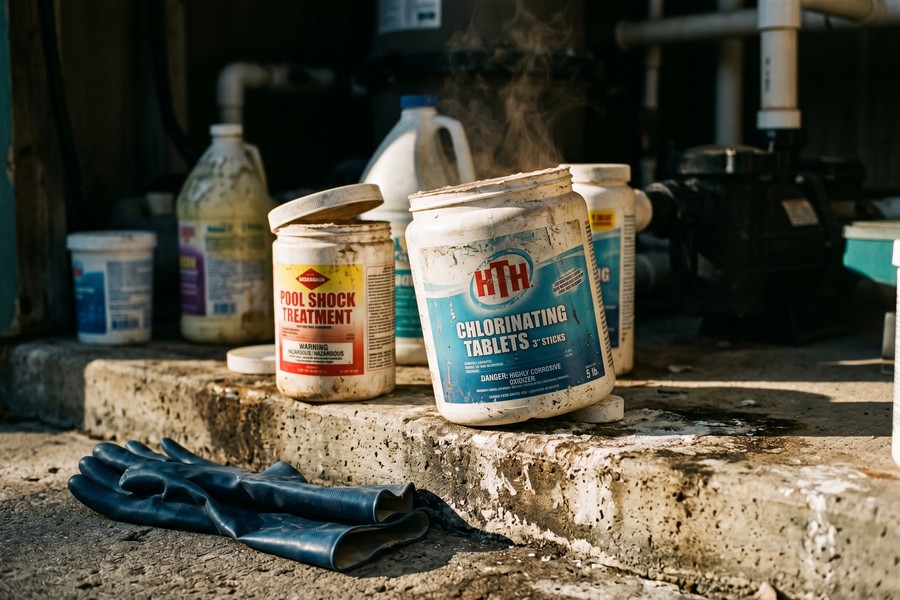
Pool chemical injuries are more common than most homeowners realize. Chlorine gas exposure, chemical burns from improperly stored pool chemicals, and contaminated water incidents can generate serious liability claims. Most standard homeowners policies contain a pollution exclusion that may bar coverage for chemical-related injuries — even those arising from your pool. Review your policy language carefully, and ask your insurer specifically how they treat pool chemical incidents.
Pool equipment failures — such as a suction entrapment incident caused by a broken drain cover — may be excluded under some policies if the equipment was known to be defective. Regular maintenance and documented inspections are your best defense against this exclusion.
Shopping for the Right Coverage as a Pool Owner
Not all insurers treat pool risk the same way. Premium variation among carriers for the same pool-owning homeowner can exceed $300 to $500 per year. Shopping your coverage — ideally through an independent insurance agent who can access multiple markets — is one of the highest-return financial exercises available to pool owners.
What to Compare When Getting Quotes
Don’t compare premiums alone. Compare the liability limits included, the medical payments limits, the other structures coverage for the pool itself, and any pool-specific exclusions. A carrier that quotes $50 less per year but excludes diving board liability is not a better deal — it’s a worse one.
Ask each carrier explicitly: “What safety features would reduce my premium, and by how much?” Some carriers offer meaningful discounts for fencing, alarms, and safety covers. Others offer flat-rate surcharges regardless of safety measures. Knowing this before you commit to a carrier helps you plan your safety investments strategically.
State-Specific Considerations
Pool insurance pricing varies significantly by state, driven by climate (longer swimming seasons mean more exposure), local court environments (some states have plaintiff-friendly courts that drive higher settlements), and state pool safety statutes. Florida, California, Texas, and Arizona — states with warm climates and large pool populations — tend to have the most competitive pool insurance markets and the most carrier experience pricing this risk.
For a state-by-state breakdown of base homeowners insurance costs before adding a pool, our homeowners insurance cost guide for 2026 provides detailed regional data. Understanding your state’s baseline helps you assess whether a pool surcharge is reasonable for your area.
Several states — including Florida, California, Arizona, Nevada, and Texas — have enacted mandatory pool barrier laws that require specific fencing and safety features. Violating these laws can void your insurance coverage AND expose you to criminal penalties in some jurisdictions.
According to the Insurance Information Institute, the average homeowners liability claim in 2023 was approximately $30,000 — but pool-related claims average significantly higher due to the severity of aquatic injuries.
Working With an Independent Agent
An independent insurance agent — one who is not captive to a single carrier — can shop your risk across dozens of companies simultaneously. For pool owners, this matters enormously because carrier appetite for pool risk varies so widely. Some national carriers actively compete for pool-owning homeowners with strong safety profiles. Others charge blanket surcharges regardless of safety features.
Provide your agent with complete documentation: pool dimensions, type, features, fencing specifications, and any safety equipment installed. The more complete your risk profile, the more accurate the quotes you receive — and the better your chance of finding a carrier that rewards your safety investments with meaningful premium reductions. Understanding the difference between actual cash value and replacement cost coverage for your pool structure is also worth discussing with your agent, as this choice affects your payout in the event of a total loss.
Real-World Example: How One Family Avoided a $1.2 Million Financial Disaster
Marcus and Diane T., a couple in suburban Atlanta, installed a 14-by-28-foot in-ground pool in the spring of 2021. The total installation cost was $52,000, including a small attached spa and a modest water slide. Their builder mentioned — in passing — that they should “let their insurance company know.” Marcus called his insurer the day after the pool was completed and disclosed the installation. His carrier increased his annual premium by $210 and required him to install a four-sided fence within 60 days.
Thirteen months later, during a Fourth of July gathering, a 7-year-old guest slipped on wet coping near the spa and suffered a serious head injury. The child was transported to the hospital and ultimately required surgery and six weeks of inpatient rehabilitation. The family’s medical bills totaled $187,000. The child’s parents retained an attorney and filed a premises liability claim against Marcus and Diane.
Because Marcus had properly disclosed the pool, maintained the required fencing, and had increased his liability limit to $300,000 (at his agent’s suggestion), his insurer accepted the claim without dispute. The $300,000 liability limit covered medical bills and a settlement. Marcus had also purchased a $1 million umbrella policy the prior year — a decision his agent had strongly recommended — and that policy was on standby had the claim exceeded the homeowners limit. Total out-of-pocket cost to Marcus and Diane: $0. Total premium they had paid for the added coverage over two years: $420 (homeowners surcharge) plus $290 (umbrella policy) — a combined $710 in premiums that stood between them and personal financial ruin.
The contrast with a neighbor’s situation makes the lesson concrete. Two streets over, a homeowner had installed a similar pool three years earlier without notifying his insurer. When a different type of injury claim arose at his property, his insurer denied coverage citing the undisclosed pool as a material misrepresentation. He faced the claim entirely on his own — spending $95,000 from savings and home equity to reach a settlement, plus $40,000 in legal defense costs. The total damage was $135,000 out of pocket, all of it avoidable with a single phone call and roughly $300 per year in additional premium.
Your Action Plan
-
Notify Your Insurer Before or Immediately After Pool Installation
Contact your insurance company or agent as soon as you sign a pool construction contract. Do not wait until the pool is complete. Provide pool dimensions, type, depth, and planned features. Confirm the notification timeline required by your policy — most require action within 30 days of a material change in risk. Get all changes confirmed in writing and request an updated declarations page.
-
Audit Your Current Liability Limits
Pull out your current homeowners policy declarations page and check your Coverage E (personal liability) limit. If it is $100,000, it is almost certainly inadequate for a pool-owning household. Contact your insurer and request a quote to raise your liability limit to $300,000 or $500,000. The cost is usually modest — $20 to $50 per additional $100,000 — and the protection is substantial.
-
Purchase an Umbrella Insurance Policy
If you don’t already have umbrella coverage, get it now — before your pool is in use. A $1 million umbrella policy costs $150 to $300 per year and provides excess liability coverage above your homeowners policy limits. If your net worth exceeds $1 million, consider a $2 million or higher limit. Shop umbrella coverage at the same time you renew or amend your homeowners policy to ensure seamless coverage.
-
Install Required and Recommended Safety Features
At minimum, install a four-sided fence at least four feet tall with a self-closing, self-latching gate. Add a pool alarm (perimeter type preferred), and consider an ASTM-rated safety cover. Remove or decline to install a diving board if your carrier requires it. Document every safety feature with photos and receipts — this documentation supports discount requests and protects you if your carrier later disputes whether features were in place.
-
Review Your Other Structures Coverage Limit
Check whether your pool’s replacement value is covered under your policy’s Coverage B (other structures) limit. This is typically set at 10% of your dwelling coverage. If your pool cost $50,000 and your other structures limit is only $40,000, you have a coverage gap. Ask your insurer about increasing the other structures limit — the premium increase is usually small.
-
Document the Pool and Maintain Maintenance Records
Take photos of your pool, fencing, safety equipment, and any safety signage immediately after installation. Keep records of all pool maintenance, chemical treatments, and equipment inspections. If a claim arises, this documentation helps demonstrate that you maintained the pool responsibly — a factor that can affect both coverage decisions and settlement negotiations.
-
Check State and Local Pool Safety Laws
Research your state and municipal pool barrier laws. Many states mandate specific fencing standards, drain cover specifications, and alarm requirements. Compliance with these laws is not just a legal requirement — it is often a condition of your insurance coverage. Non-compliance can void coverage and expose you to fines. Your local building department can provide specific requirements for your jurisdiction.
-
Shop Your Coverage Annually
The pool insurance market is competitive and carrier pricing changes regularly. Review your coverage at each renewal — or whenever a safety feature is added — to ensure you’re getting the best combination of price and protection. Use an independent agent who can access multiple carriers simultaneously. Pool-specific discounts for safety features are available from many carriers and are often not applied automatically — you have to ask.
Frequently Asked Questions
Does a swimming pool automatically increase my homeowners insurance premium?
In most cases, yes. Virtually all insurers view a swimming pool as an increased liability risk and an increase in insurable property value, both of which typically result in higher premiums. The exact increase varies by carrier, pool type, location, and safety features — but a range of 10% to 25% is typical for in-ground pools. Above-ground pools generally trigger smaller increases.
What happens if I don’t tell my insurer about my pool?
Failing to disclose a pool is a material misrepresentation that can give your insurer grounds to deny a claim or cancel your policy. If a pool-related injury occurs and your insurer discovers you never disclosed the pool, you may be left personally responsible for the entire claim — including medical bills, legal defense costs, and any judgment. The consequences can be financially catastrophic. Always notify your insurer in writing as soon as possible.
How much liability coverage do pool owners actually need?
At a minimum, pool owners should carry $300,000 in personal liability coverage through their homeowners policy. Most experts recommend $500,000 plus a $1 million umbrella policy. If your net worth exceeds $1 million, your umbrella coverage should match or exceed your total assets. Pool-related injury claims — especially those involving children or catastrophic injuries — can generate judgments well above $1 million.
Are diving boards covered by homeowners insurance?
It depends on the carrier. Many insurers will not write a policy on a home with a diving board, or they will specifically exclude diving board-related claims. Those that do cover diving boards often charge significant additional premiums. If your pool has a diving board and you’re shopping for coverage, disclose this upfront — discovering after a claim that your diving board was excluded is a costly surprise.
Does homeowners insurance cover pool damage from storms or vandalism?
Coverage for pool damage depends on how the pool is classified and what caused the damage. In-ground pools classified as “other structures” are typically covered for damage from named perils such as fire, vandalism, and windstorm — but not flooding (which requires separate flood insurance) and not general wear and tear. Pool equipment and mechanical systems may have separate coverage limitations. Review your policy carefully and ask your agent specifically about pool damage scenarios.
Is my pool covered if I rent my home on Airbnb?
Almost certainly not under a standard homeowners policy. Standard policies exclude incidents that occur during rental periods because the business use triggers a commercial exclusion. If you rent your home — even for a single weekend — you need a short-term rental endorsement or a separate vacation rental policy that specifically covers pool use by paying guests. Failure to have this coverage is one of the most common — and expensive — gaps in vacation rental insurance.
Do pool safety features actually reduce my insurance premium?
Yes, with many carriers. Four-sided fencing, self-latching gates, pool alarms, and ASTM-rated safety covers can collectively reduce your pool-related liability surcharge by up to 10%. The exact discount varies by carrier — some offer meaningful reductions, others charge flat surcharges regardless of safety features. When shopping coverage, ask each carrier specifically what discounts are available for safety equipment. This question can save you $50 to $150 per year.
Does my homeowners insurance cover pool chemical injuries?
This is an area where policy language varies significantly. Most standard homeowners policies contain a pollution exclusion that may bar coverage for injuries caused by pool chemicals — including chlorine gas exposure or chemical burns. Some policies have exceptions for “sudden and accidental” releases. Review your specific policy language and ask your insurer directly. If your policy excludes pool chemical incidents, ask about endorsements that can fill this gap.
Can my insurer drop me because I have a pool?
Yes — though this is more likely if you have a diving board, a history of claims, or a pool that doesn’t meet the insurer’s safety requirements. Some carriers simply do not underwrite homes with certain pool features as a matter of underwriting policy. If your current insurer drops you or declines to renew due to your pool, you have options: work with an independent agent to find a carrier that actively covers pool-owning homeowners, or address the specific risk factors (such as removing a diving board) that triggered the non-renewal.
How does my pool affect my homeowners insurance if I’m selling my home?
A pool can increase your home’s market value and attractiveness to buyers — but it also transfers liability considerations to the new owner. When selling, disclose the pool fully in your property disclosure. The buyer’s insurer will ask about the pool, and if it wasn’t disclosed during the sale, there can be legal complications. As the seller, your liability exposure generally ends at closing, though claims related to incidents that occurred during your ownership can still arise afterward.
Sources
- Centers for Disease Control and Prevention — Drowning Facts and Data
- Centers for Disease Control and Prevention — Drowning Prevention Strategies
- Insurance Information Institute — Homeowners and Renters Insurance Facts and Statistics
- Insurance Information Institute — What Is Covered by Standard Homeowners Insurance
- Insurance Information Institute — Swimming Pools and Insurance
- National Fire Protection Association — Pool Safety Standards Overview
- USA.gov — Home Insurance Basics
- Consumer Financial Protection Bureau — What You Should Know About Homeowners Insurance
- National Association of Insurance Commissioners — Homeowners Insurance Consumer Alert
- Pool Safely (U.S. Consumer Product Safety Commission) — Pool and Spa Safety Resources
- U.S. Consumer Product Safety Commission — Pool Safety Education Center
- Florida Office of Insurance Regulation — Pool Safety and Insurance Requirements
- Insurance Information Institute — Umbrella Insurance Explained