Fact-checked by the The Insurance Scout editorial team
Quick Answer
Classic car insurance is a specialized policy for vehicles typically 25 or more years old, offering agreed value coverage at premiums averaging $200–$600 per year — far less than standard auto insurance. As of July 2025, collectors need to compare agreed value versus stated value policies, meet mileage restrictions, and choose a specialist insurer to get the right protection.
Getting the right classic car insurance means understanding that your 1967 Mustang or 1955 Bel Air is not covered the way your daily driver is — and that standard auto policies will leave you badly underinsured if something goes wrong. According to Hagerty’s classic car insurance research, the collectible vehicle market exceeded $35 billion in value in recent years, yet the majority of collectors still carry inadequate coverage. As of July 2025, specialist insurers have made it easier than ever to protect your investment properly.
The collectible car market has surged since 2020, with auction prices for desirable models climbing 30–50% in some segments according to industry data. That appreciation is exactly why the gap between a standard policy payout and your car’s real market value has never been larger — or more dangerous to ignore.
This guide is for collectors, weekend drivers, restorers, and anyone who owns a vehicle they care deeply about. By the end, you will know how to qualify for coverage, choose the right policy type, find the best insurer, and avoid the mistakes that leave claims unpaid.
Key Takeaways
- Agreed value policies pay 100% of the insured amount with no depreciation deduction, according to Hagerty’s coverage explainer.
- Most classic car insurers require fewer than 2,500–5,000 miles per year, making these policies unsuitable for daily commuters, per industry underwriting guidelines.
- Classic car insurance premiums average $200–$600 annually, compared to the national average of $1,765 per year for standard auto insurance according to Bankrate’s 2025 auto insurance data.
- The Hagerty Vehicle Rating system grades cars from 1 (poor) to 6 (concours) — a higher grade typically reduces your premium by 10–20% for well-documented restorations.
- Vehicles must usually be stored in a locked, enclosed garage to qualify for most specialty policies — street parking typically disqualifies coverage.
- Choosing the wrong coverage type — stated value instead of agreed value — can cost collectors tens of thousands of dollars at claim time due to depreciation calculations.
In This Guide
- Step 1: Does My Car Qualify for Classic Car Insurance?
- Step 2: What Is the Difference Between Agreed Value and Stated Value?
- Step 3: How Much Classic Car Insurance Coverage Do I Actually Need?
- Step 4: Which Classic Car Insurance Companies Are Worth Using?
- Step 5: How Do I Get a Classic Car Insurance Quote and What Information Do I Need?
- Step 6: How Do Mileage Restrictions Work and Will They Affect Me?
- Frequently Asked Questions
Step 1: Does My Car Qualify for Classic Car Insurance?
Your vehicle qualifies for classic car insurance if it is typically 25 years old or older, used primarily for pleasure driving, stored in a secured garage, and maintained in good condition. Some insurers extend eligibility to vehicles as young as 15 years old for limited-production or collectible models.
How to Determine Eligibility
The most commonly used age thresholds are 15 years old for specialty vehicles and 25 years old for standard classics — though definitions vary by insurer. Hagerty, one of the leading specialty insurers, covers vehicles across a wide range of categories including muscle cars, vintage trucks, exotic imports, and motorcycles.
Beyond age, insurers evaluate several factors:
- Primary storage must be in a locked, enclosed structure such as a private garage or climate-controlled storage facility.
- The vehicle must not be used as a daily driver — most policies prohibit commuting, business use, or regular grocery runs.
- The owner typically must have a clean driving record and a separate primary vehicle for daily use.
- The car must be in good working condition or undergoing active, documented restoration.
What to Watch Out For
Vehicles used for racing, track days, or timed events are almost universally excluded from standard classic car policies — you would need a separate track day or motorsport policy. Also, if the vehicle is titled as a salvage or rebuilt title, many specialty insurers will decline coverage or offer reduced limits.
Classic cars actually depreciate less during economic downturns than standard vehicles. The Hagerty Market Rating showed collectible car values remained 15–20% more stable than the broader used car market during recent market corrections.
Step 2: What Is the Difference Between Agreed Value and Stated Value?
Agreed value and stated value are the two main coverage structures for classic car insurance — and choosing the wrong one can cost you tens of thousands of dollars at claim time. With agreed value, the insurer pays the full insured amount if the car is totaled, with zero depreciation. With stated value, the insurer pays the lesser of the stated amount or the actual cash value at the time of the loss.
How to Choose the Right Structure
For most collectors, agreed value is the correct choice. If you insure your 1969 Camaro at an agreed value of $75,000 and it is stolen, you receive $75,000 — period. Under a stated value policy, the insurer could pay far less if they determine the vehicle’s actual cash value had depreciated since the policy was written.
The distinction matters enormously for appreciating assets. As noted in our guide to actual cash value versus replacement cost coverage, depreciation calculations can dramatically reduce what you receive after a loss — and classic cars often appreciate rather than depreciate, making agreed value even more critical.
What to Watch Out For
Some insurers market policies as “agreed value” but include clauses that allow them to dispute the valuation at claim time. Always read the policy language carefully. Look for phrases like “we will pay the agreed amount” without qualifying language about market conditions or depreciation.
“The single biggest mistake classic car owners make is assuming their standard auto policy or a generic stated value policy will make them whole after a total loss. Agreed value coverage is non-negotiable for any vehicle that has appreciated or been restored.”

Step 3: How Much Classic Car Insurance Coverage Do I Actually Need?
You need coverage equal to the current market value of your vehicle — not what you paid for it, and not a round number you picked arbitrarily. The correct insured value should be based on a professional appraisal or documented comparable sales from auction results.
How to Determine the Right Coverage Amount
There are three reliable methods for establishing your vehicle’s insured value:
- Professional appraisal — A certified appraiser from organizations like the American Society of Appraisers provides the most defensible valuation for high-value vehicles.
- Comparable auction results — Reference recent hammer prices from Mecum Auctions, Barrett-Jackson, or RM Sotheby’s for your specific year, make, model, and condition grade.
- Published price guides — Hagerty’s free Valuation Tools database tracks values for thousands of vehicles by condition grade.
For liability coverage, specialty policies typically offer the same liability limits as standard auto policies — commonly $100,000/$300,000 bodily injury and $100,000 property damage. Given the high repair costs of vintage vehicles involved in accidents, carrying higher liability limits is wise.
What to Watch Out For
Do not underinsure to save on premiums. If your vehicle appreciates and you have not updated your agreed value, you are leaving money on the table at claim time. Review and update your insured value annually, especially in a rising market.
Photograph your vehicle thoroughly — inside, outside, under the hood, and under the car — and store photos in a cloud service like Google Photos with the date stamp visible. This documentation dramatically accelerates the claims process and helps defend your stated value if it is ever disputed.
Understanding how coverage decisions affect your overall insurance portfolio is important. Just as you would review your liability exposure across policies, consider how an umbrella policy might interact with your classic car coverage — see our breakdown of umbrella insurance versus excess liability for context.
| Coverage Type | Payout at Total Loss | Annual Premium (Avg) | Best For |
|---|---|---|---|
| Agreed Value | 100% of agreed amount — no depreciation | $200–$600/year | All serious collectors; appreciating vehicles |
| Stated Value | Lesser of stated amount or ACV at loss date | $150–$450/year | Lower-value project cars with uncertain worth |
| Standard Auto (ACV) | Depreciated market value at loss date | $1,200–$2,500/year | Daily drivers; vehicles under 15 years old |
| Replacement Cost | Cost to replace with equivalent vehicle | Rarely available for classics | Late-model collectibles with clear comps |
The average classic car insurance premium is $263 per year according to Hagerty’s underwriting data — roughly 85% less than the national average for standard auto coverage, reflecting the low mileage and careful storage conditions of most collector vehicles.
Step 4: Which Classic Car Insurance Companies Are Worth Using?
The best classic car insurance companies are specialty insurers who understand the collector vehicle market — not standard auto insurers offering a modified version of their regular product. The top-rated specialists in July 2025 are Hagerty, Grundy, American Collectors Insurance, J.C. Taylor, and Heacock Classic.
How to Evaluate Insurers
Hagerty is the largest classic car insurer in North America, known for agreed value coverage, flexible mileage plans, and a robust claims network that understands vintage vehicles. Their policies also include roadside assistance tailored to collector cars and access to their Driver’s Club membership benefits.
Grundy Insurance was among the first specialty classic car insurers and is credited with pioneering agreed value coverage for collectibles. Grundy offers a unique benefit: their policies include an automatic automatic value appreciation clause that adjusts coverage if the vehicle’s value increases between policy renewals.
American Collectors Insurance is known for competitive pricing on vehicles in the $5,000–$50,000 range, making it a strong choice for enthusiasts who own mid-tier classics rather than six-figure show cars. Their policies are available in all 50 states.
What to Watch Out For
Be cautious of standard auto insurers — including GEICO, State Farm, and Progressive — who offer “classic car” endorsements on standard policies. These products often use stated value or actual cash value payouts rather than true agreed value, and their adjusters may not be experienced with collector vehicle valuations.
Some insurers require that the policyholder be 25 years of age or older to qualify for classic car coverage. Younger collectors may face limited options or higher premiums. Always confirm age requirements before requesting a quote.

Step 5: How Do I Get a Classic Car Insurance Quote and What Information Do I Need?
Getting a classic car insurance quote takes as little as 10–15 minutes online if you have the required information ready. You will need the vehicle’s VIN, current agreed value documentation, storage location details, your driving record, and information about your primary daily-use vehicle.
How to Do This
Follow these steps to gather and submit a quote request:
- Obtain your vehicle’s VIN — found on the dashboard near the windshield or inside the driver’s door frame.
- Document the current value — use Hagerty’s Valuation Tools, a recent appraisal, or comparable auction results. Have a dollar figure ready before you start.
- Confirm your storage details — the insurer will ask whether storage is in a private garage, commercial storage, or climate-controlled facility.
- Estimate annual mileage — be honest. Most classic policies offer mileage tiers of 1,000, 2,500, 5,000, and unlimited pleasure use.
- Have your driving history ready — insurers will ask about accidents, violations, and DUIs in the past 3–5 years.
- Request quotes from at least three specialty insurers — compare Hagerty, Grundy, and American Collectors Insurance as a baseline.
Most specialty insurers allow you to bind coverage online the same day. Some may require a physical inspection or photographic documentation before issuing a policy on vehicles valued above $150,000.
What to Watch Out For
Underreporting your vehicle’s value to lower your premium is a serious mistake. If you insure a $90,000 vehicle for $50,000 to save $80 per year and it is totaled, you absorb the $40,000 gap yourself. The premium savings never justify the coverage gap.
It is also worth reviewing how a new classic car policy fits into your broader insurance picture. If you have recently acquired a collector vehicle after a major life event, our guide on updating your insurance after a major life event walks through everything that may need to change across your policies.
Many specialty insurers offer a multi-vehicle discount if you insure two or more collector vehicles under the same policy. If you own a classic car and a vintage motorcycle, bundling them can reduce total premiums by 5–15%.
Step 6: How Do Mileage Restrictions Work and Will They Affect Me?
Mileage restrictions are a defining feature of classic car insurance, and most policies cap annual driving at 2,500–5,000 miles. These limits exist because low mileage is a core reason premiums are so affordable — but exceeding your limit can void your coverage at claim time.
How Mileage Tiers Work
Specialty insurers typically offer tiered mileage options:
- Limited (1,000–2,500 miles/year) — lowest premium tier; suitable for show cars and occasional parade use.
- Standard pleasure use (2,500–5,000 miles/year) — the most common tier for weekend drivers and club members.
- Enhanced pleasure use (5,000–7,500 miles/year) — available from some insurers for drivers who participate in tours, rallies, or extended road trips.
- Unlimited pleasure use — offered by Hagerty and a few others; prohibits commuting but does not cap total miles.
Hagerty’s “Unlimited Miles” plan is notable because it removes the odometer anxiety many drivers feel while still restricting the vehicle from daily commuting, rideshare, or business use. This is a strong option for active driving enthusiasts who regularly join tours and road events.
What to Watch Out For
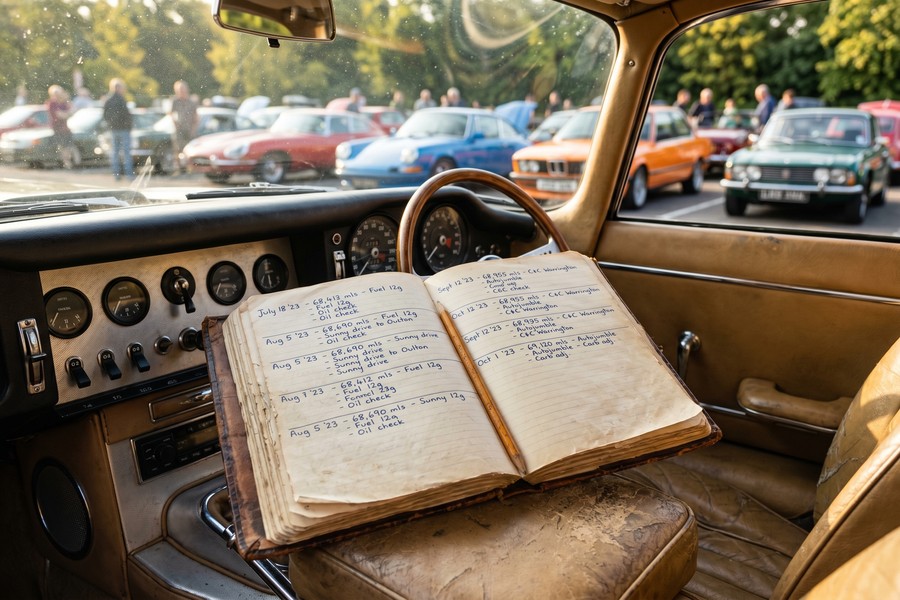
If you participate in Cars and Coffee events, concours d’elegance shows, or multi-day touring rallies, your mileage can add up faster than you expect. Track your odometer at the start of each policy year and monitor it throughout the season.
Commuting — even once — on a classic car policy is a policy violation at most insurers. If you drive your classic to work on a day your regular car is in the shop and have an accident, the insurer may deny the claim on the grounds that the vehicle was used outside the policy’s intended purpose.
Filing a claim on a classic car policy after exceeding your annual mileage limit can result in claim denial and policy cancellation. Exceeding mileage is considered a material misrepresentation by most specialty insurers, regardless of whether the excess miles contributed to the loss.
Understanding how auto insurance claims work — and where they can go wrong — applies to classic car policies too. Our article on mistakes drivers make when filing auto insurance claims covers several pitfalls that are directly relevant to collector car claims.
“Weekend drivers and show car owners are often pleasantly surprised by how affordable proper agreed value coverage is. The key is being honest about usage — those restrictions are what keep premiums low for everyone in the collector community.”
One final consideration: classic car ownership often overlaps with other significant assets. If your collection represents a substantial portion of your net worth, it is worth reviewing whether your overall liability exposure is adequately covered — the same way homeowners think about coverage gaps that lead to denied claims. The principles of documentation, honest disclosure, and adequate limits apply across all specialty lines.
Frequently Asked Questions
How old does a car have to be to qualify for classic car insurance?
Most specialty insurers require a vehicle to be at least 25 years old for standard classic coverage, though some insurers — including Hagerty — extend eligibility to vehicles 15 years or older if they are limited-production, collectible, or significantly appreciating in value. The key qualifier is always intended use: the vehicle must be a pleasure-use vehicle, not a daily driver.
Can I drive my classic car every day and still get classic car insurance?
No — classic car insurance explicitly prohibits daily commuting, and most policies will be voided if the vehicle is used as a primary transportation vehicle. You must own and regularly use a separate vehicle for daily driving to qualify. Some insurers verify this by requiring you to list your primary daily-use vehicle on the application.
What happens if I get into an accident with my classic car — will my insurer understand how to value vintage parts?
Specialty classic car insurers like Hagerty and Grundy use claims adjusters who are specifically trained in collector vehicle valuations and can source vintage, NOS (new old stock), and reproduction parts. Standard auto insurers typically lack this expertise and may try to settle claims using non-original replacement parts that reduce the vehicle’s value. This is one of the strongest reasons to use a specialty insurer.
Is classic car insurance cheaper than regular car insurance?
Yes — classic car insurance is dramatically cheaper than standard auto coverage because of strict mileage limits and careful storage requirements. The average classic car policy costs $200–$600 per year, compared to the national average of $1,765 annually for standard auto insurance according to Bankrate’s 2025 rate data. Lower mileage means lower exposure, which translates directly to lower premiums.
Can I get classic car insurance for a vehicle I am still restoring?
Yes — most specialty insurers offer restoration coverage for vehicles that are not yet drivable. Policies typically cover the vehicle while it is in your garage or a professional restoration shop, protecting against fire, theft, flood, and vandalism during the build. You will need to provide documentation of the restoration status and an estimated completion value.
Do I need a separate policy for my classic car, or can I add it to my regular auto policy?
You should get a separate specialty policy rather than adding your classic to a standard auto policy. Standard auto policies use actual cash value or stated value payout structures that depreciate your vehicle at claim time — exactly the wrong approach for a vehicle that has appreciated. A standalone classic car policy from a specialty insurer provides agreed value coverage and claims handling by experts who understand collector vehicles.
Will my classic car insurance cover me at car shows and cruise nights?
Yes — attending car shows, cruise nights, concours d’elegance events, and club tours is explicitly included in the “pleasure use” definition used by all major specialty insurers. However, timed racing events, track days, and autocross competition are universally excluded and require a separate motorsport or track day policy. Always confirm event-specific coverage with your insurer before participating in anything with a timer or closed course.
How do I prove my classic car’s value to an insurance company?
The three most accepted methods are a professional appraisal from a certified appraiser, comparable auction results from Barrett-Jackson, Mecum, or RM Sotheby’s for your specific vehicle, and published condition-adjusted valuations from tools like Hagerty Valuation Tools. For vehicles valued above $50,000, most insurers prefer a written appraisal. Maintain a thorough photo record and keep all receipts for restoration work — documented modifications and original-parts restorations significantly increase defensible value.
What is not covered by classic car insurance?
Classic car insurance typically excludes racing and timed competition, commercial use, rideshare driving, and regular daily commuting. Mechanical breakdown and wear-and-tear are not covered — these are considered maintenance issues, not insurable losses. Some policies also exclude coverage if the vehicle is stored at a business address or driven by someone not listed on the policy. Always read your exclusions section before binding coverage.
Should I get an appraisal before insuring my classic car?
A professional appraisal is strongly recommended for any vehicle valued above $25,000 or any restored vehicle where your investment in labor and parts exceeds the vehicle’s pre-restoration market value. An appraisal creates a defensible paper trail that makes the claims process faster and reduces disputes over value. For vehicles under $25,000, comparable sales data from Hagerty Valuation Tools or recent auction results may be sufficient. If you are unsure which approach fits your situation, our article on actual cash value versus replacement cost explains the valuation concepts your insurer will use.
Sources
- Hagerty — Classic Car Insurance Guide
- Hagerty — Agreed Value vs. Stated Value Explained
- Hagerty — Hagerty Market Rating Methodology
- Bankrate — Average Cost of Car Insurance 2025
- American Society of Appraisers — Find a Certified Appraiser
- Grundy Insurance — Classic Car Insurance Overview
- American Collectors Insurance — Collector Car Coverage
- National Association of Insurance Commissioners — Classic Car Insurance Overview
- Insurance Information Institute — Auto Insurance Basics
- Barrett-Jackson — Collector Car Market Report