Fact-checked by the The Insurance Scout editorial team
Quick Answer
Liability car insurance covers bodily injury and property damage you cause to others in an at-fault accident. As of May 2026, minimum state limits — often as low as $25,000 per person — fall dangerously short of average crash costs, which now exceed $61,000 per injury claim according to the Insurance Research Council.
Understanding what does liability car insurance cover is more urgent in 2026 than at any point in the past decade. As of May 2026, liability-only policies remain the most common form of auto coverage in the United States, carried by an estimated 28% of all insured drivers according to the Insurance Information Institute (III) — yet most of those drivers have no clear picture of where that coverage ends and their personal financial exposure begins.
The gap between what liability coverage actually pays and what modern accidents actually cost has widened dramatically. According to the National Safety Council (NSC), the average economic cost of a disabling injury from a motor vehicle crash reached $101,000 in 2024, a figure that easily overwhelms the minimum limits mandated by most states. Research from the Insurance Research Council (IRC) further confirms that claim severity — the average dollar amount paid per injury claim — has risen at nearly twice the rate of general inflation since 2020.
This guide gives you a precise, line-by-line breakdown of what liability auto insurance covers, what it excludes, exactly how state minimums stack up against real-world accident costs in 2026, and a concrete action plan for deciding whether your current limits are enough to protect your financial future. You will leave with specific numbers, comparison tables, and a step-by-step framework — not generalities.
Key Takeaways
- Liability car insurance covers two components: Bodily Injury Liability (BIL) and Property Damage Liability (PDL) — it does NOT cover your own injuries or vehicle damage (Insurance Information Institute, 2025).
- The national median minimum BIL limit is $25,000 per person / $50,000 per accident, unchanged in most states since the 1970s despite injury costs rising more than 400% (Insurance Research Council, 2025).
- The average liability claim for a rear-end collision with injuries now costs $24,211 in property damage and medical costs combined, with serious multi-vehicle crashes routinely exceeding $500,000 (National Safety Council, 2024).
- Drivers carrying only minimum limits risk having wages garnished, bank accounts levied, and assets seized if a judgment exceeds their policy limit — exposure affecting an estimated 1 in 6 at-fault drivers annually (IRC, 2024).
- Raising BIL limits from 25/50 to 100/300 costs an average of $12–$18 per month more in premium — less than the cost of two lattes — but provides up to $250,000 in additional coverage per incident (J.D. Power Auto Insurance Study, 2025).
- Umbrella insurance policies, which extend liability protection by $1 million or more, cost an average of $150–$300 per year and are held by fewer than 10% of U.S. drivers (III, 2025).
In This Guide
- What Is Liability Car Insurance, Exactly?
- What Does Bodily Injury Liability Cover?
- What Does Property Damage Liability Cover?
- What Does Liability Car Insurance NOT Cover?
- How Do State Minimum Limits Compare to Real Accident Costs in 2026?
- How Much Liability Coverage Do You Actually Need?
- What Happens When Your Liability Limits Are Too Low?
- How Does Umbrella Insurance Extend Your Liability Protection?
- How Has 2026 Changed the Liability Insurance Landscape?
What Is Liability Car Insurance, Exactly?
Liability car insurance is a policy component that pays for losses you cause to other people when you are at fault in an auto accident. It is the single coverage type required by law in 49 U.S. states (New Hampshire allows drivers to post a financial bond instead), according to the Insurance Information Institute. If you are new to auto coverage entirely, our primer on auto insurance fundamentals and why every driver needs it provides helpful context before diving into the specifics of liability.
The policy does not protect you — it protects everyone else on the road from you. That distinction is the most important concept any driver can understand about what does liability car insurance cover.
The Two Sub-Components of Liability Coverage
Every standard liability auto policy is divided into two distinct sub-coverages. Bodily Injury Liability (BIL) pays for physical harm to other people. Property Damage Liability (PDL) pays for damage to other people’s vehicles, structures, and belongings.
Both sub-coverages are purchased together and listed on your declarations page as a three-number shorthand: for example, 25/50/25 means $25,000 per injured person, $50,000 per accident for all injuries combined, and $25,000 for all property damage per accident.
How Split-Limit vs. Combined Single Limit Policies Differ
Most drivers carry split-limit policies, which impose separate caps on per-person and per-accident injury payouts. A smaller number of insurers — and several commercial policies — offer combined single limit (CSL) coverage, which pools bodily injury and property damage into one total amount (e.g., $300,000 CSL). CSL policies are generally more flexible in complex multi-victim crashes but carry higher base premiums.
Liability insurance does not follow the vehicle — it follows the driver. If you borrow a friend’s car and cause an accident, their policy typically pays first, but your policy may be called upon as excess coverage if their limits are exhausted.
What Does Bodily Injury Liability Cover?
Bodily Injury Liability pays for the physical and financial harm suffered by other people — drivers, passengers, pedestrians, and cyclists — when you cause an accident. Coverage is broad and includes multiple categories of damages that extend well beyond immediate hospital bills.
Specific Expenses BIL Covers
BIL pays for the following categories of loss for each injured third party:
- Emergency medical treatment, surgery, and hospitalization
- Ambulance and emergency transport fees
- Ongoing rehabilitation, physical therapy, and follow-up care
- Lost wages if the injured party cannot work during recovery
- Pain and suffering damages awarded in a civil lawsuit
- Funeral and burial expenses in fatal accidents
- Legal defense costs if the injured party sues you (up to the policy limit)
According to the National Safety Council, the comprehensive cost of a fatal crash — including lost productivity, medical costs, and administrative expenses — averaged $1.78 million per fatality in 2024. No minimum-limit policy comes close to covering that figure.
The average jury verdict in auto accident litigation reached $417,000 in 2023, more than tripling since 2015, driven largely by “nuclear verdicts” in personal injury cases (Swiss Re Institute, 2024). Minimum liability limits cover less than 6% of that figure.
What BIL Pays for Your Legal Defense
One underappreciated aspect of BIL is that it funds your legal defense in any lawsuit arising from a covered accident — even if the suit is ultimately determined to be your fault. Insurers assign defense attorneys and cover litigation costs, but those costs typically count against your total policy limit. Once your limit is exhausted, the insurer’s obligation ends and you bear personal liability for any remaining judgment.
What Does Property Damage Liability Cover?
Property Damage Liability covers the cost to repair or replace physical property belonging to others that you damage in an at-fault accident. This goes far beyond just the other driver’s car.
What Counts as Covered Property
PDL covers damage to a wide range of property types, including:
- The other driver’s vehicle — repair costs or actual cash value if totaled
- Fences, mailboxes, and landscaping on private property
- Buildings, storefronts, or walls struck during an accident
- Traffic signals, guardrails, and government infrastructure
- Personal belongings inside another vehicle (in some states)
The average cost to repair a late-model sedan after a collision reached $5,700 in 2024 according to CCC Intelligent Solutions, but luxury vehicles, SUVs, and electric vehicles routinely generate repair bills of $15,000 to $30,000 or more due to complex sensors and battery systems.
The standard state minimum PDL limit of $10,000 to $25,000 is frequently insufficient to cover a single modern EV or luxury SUV. If the at-fault driver’s PDL limit is exhausted, they owe the balance personally — and the damaged party can sue to collect.
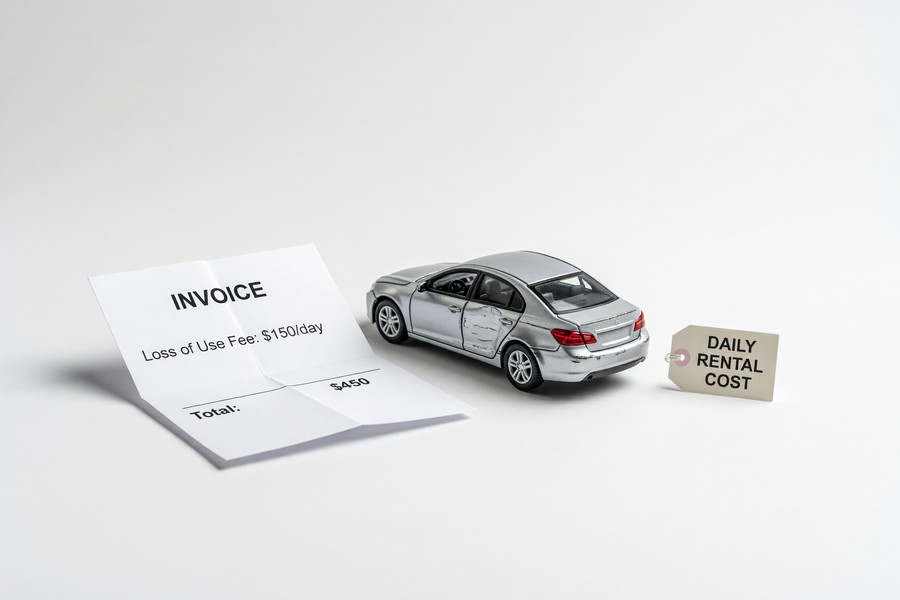
Rental Car Loss-of-Use Fees
PDL may also cover loss-of-use fees — the daily rental cost the other vehicle’s owner incurs while their car is being repaired. These charges accumulate quickly, especially when supply-chain delays extend repair timelines. Some insurers cap loss-of-use reimbursement, so it is critical to verify your policy language.
What Does Liability Car Insurance NOT Cover?
Liability car insurance covers only third-party losses — it covers nothing related to you, your passengers, or your own vehicle. This is the exclusion zone that leaves many drivers financially exposed after an accident.
Key Exclusions Every Driver Must Know
The following losses are not covered under a liability-only policy:
- Damage to your own vehicle from a collision
- Theft of your vehicle or belongings inside it
- Medical bills for you or your passengers
- Lost wages resulting from your own injuries
- Damage caused by weather, flooding, or natural disasters
- Damage from hitting an animal
- Uninsured motorist damage to your vehicle
- Intentional damage or criminal acts
To cover your own injuries, you need Personal Injury Protection (PIP) or Medical Payments (MedPay) coverage. To cover your own vehicle, you need Collision and Comprehensive coverage. Our overview of auto insurance fundamentals breaks down all coverage types in detail.
The Uninsured Motorist Gap
One of the most dangerous gaps in liability-only policies involves accidents caused by uninsured or underinsured drivers. According to the Insurance Research Council, 1 in 7 U.S. drivers — roughly 14% of the driving population — carried no insurance in 2024. If an uninsured driver hits you, your liability policy pays nothing toward your own damages. Uninsured Motorist (UM) and Underinsured Motorist (UIM) coverage must be added separately to fill this gap.
In no-fault states like Florida, Michigan, and New York, drivers must carry Personal Injury Protection (PIP) that covers their own medical costs regardless of fault. Even so, PIP does NOT replace liability insurance — you still need BIL and PDL to cover the damages you cause to others.
How Do State Minimum Limits Compare to Real Accident Costs in 2026?
State minimum liability limits are dangerously inadequate in 2026. Most were set decades ago and have never been adjusted for medical inflation, rising litigation costs, or the increasing repair complexity of modern vehicles.
State Minimum Limits vs. Average Claim Costs
| State | Minimum BIL Limit | Minimum PDL Limit | Avg. Injury Claim Cost (2024) |
|---|---|---|---|
| Florida | $10,000 PIP only* | $10,000 | $24,211 |
| California | $15,000 / $30,000 | $5,000 | $24,211 |
| Texas | $30,000 / $60,000 | $25,000 | $24,211 |
| New York | $25,000 / $50,000 | $10,000 | $24,211 |
| Alaska | $50,000 / $100,000 | $25,000 | $24,211 |
| Maine | $50,000 / $100,000 | $25,000 | $24,211 |
*Florida does not require BIL coverage for most private passenger vehicles, making it the most underprotected state for liability in the country. Average injury claim cost sourced from National Safety Council (2024).
California’s $5,000 PDL minimum — unchanged since 1967 — covers less than half the cost of repairing even an economy sedan today. In January 2025, California did raise its BIL minimums for the first time in decades, moving from 15/30 to 30/60, but experts at the IRC argue that even 30/60 remains inadequate given average verdict sizes.
“Minimum liability limits were designed for a different era of American motoring. In 2026, they represent a floor of coverage so low that carrying them is little more than legal compliance — they provide almost no real financial protection in a serious accident.”
How Medical Inflation Has Outpaced Minimum Limits
Medical care inflation averaged 4.6% annually between 2015 and 2024, according to the U.S. Bureau of Labor Statistics Consumer Price Index. Over that same period, the majority of states made no adjustment to their minimum BIL requirements. A $25,000 limit set in 1990 would need to be approximately $58,000 today just to maintain the same purchasing power in medical costs. For a deeper look at how healthcare cost inflation is compounding insurance exposure across all policy types, our analysis of why medical insurance premiums could skyrocket in 2026 provides important additional context.

How Much Liability Coverage Do You Actually Need?
Most insurance professionals recommend carrying at least 100/300/100 in liability coverage — $100,000 per person, $300,000 per accident for injuries, and $100,000 for property damage. This is the threshold most commonly cited by the Consumer Federation of America as the minimum for meaningful protection.
Coverage Tier Comparison: Cost vs. Protection
| Coverage Tier | BIL Per Person | BIL Per Accident | PDL | Avg. Annual Premium Add-On |
|---|---|---|---|---|
| State Minimum | $25,000 | $50,000 | $25,000 | Baseline ($0 extra) |
| Mid-Level | $50,000 | $100,000 | $50,000 | +$80–$120/year |
| Recommended | $100,000 | $300,000 | $100,000 | +$144–$216/year |
| High-Asset | $250,000 | $500,000 | $100,000 | +$240–$360/year |
| + Umbrella ($1M) | $250,000 | $500,000 | $100,000 | +$390–$660/year total |
Premium estimates based on J.D. Power Auto Insurance Study (2025) and Insurance Information Institute industry data (2025). Individual rates vary by state, driving history, and insurer.
The jump from state minimum to the recommended 100/300/100 costs most drivers less than $18 per month — a fraction of the financial risk they eliminate. If you want to understand more about how these premiums are calculated, our article on getting car insurance quotes made simple explains the rating factors insurers use.
The Net-Worth Rule for Liability Limits
A widely used rule among financial planners: your total liability coverage — including any umbrella policy — should equal or exceed your net worth. This is because a court judgment can attach to assets including bank accounts, investment portfolios, real estate equity, and future wages. Drivers with a net worth of $300,000 or more who carry only minimum limits are taking a serious and unnecessary financial risk.
When comparing liability limits and pricing, always get quotes at three tiers simultaneously: state minimum, 100/300/100, and 100/300/100 plus a $1 million umbrella. The incremental cost between the first and third option is almost always smaller than drivers expect — often less than $400 per year — while the protection difference is enormous.
What Happens When Your Liability Limits Are Too Low?
When an at-fault accident generates damages that exceed your liability limits, your insurer pays its maximum and then stops. Every dollar of the remaining judgment becomes your personal legal obligation — immediately and directly.
The Legal Consequences of Underinsurance
An injured party who wins a judgment larger than your policy limits can pursue collection through:
- Wage garnishment — a court can order your employer to withhold a portion of your paycheck until the debt is satisfied
- Bank account levies — funds in checking and savings accounts can be seized
- Property liens — a lien can be placed against your home, preventing sale or refinancing until paid
- Investment account liquidation — brokerage accounts may be subject to court-ordered liquidation in some states
Certain assets are protected by state exemption laws — primary residence equity up to a specified amount, retirement accounts under ERISA, and basic personal property — but the specifics vary dramatically by state, and protection is far from guaranteed.
Approximately $4.1 billion in auto liability claims exceeded policy limits in 2023, leaving at-fault drivers personally responsible for the balance (Insurance Research Council, 2024). This figure has grown 38% since 2019.
How “Nuclear Verdicts” Are Changing the Risk Calculus
The rise of nuclear verdicts — jury awards exceeding $10 million — in personal injury cases has fundamentally shifted the liability landscape. The Swiss Re Institute documented a 300% increase in verdicts over $10 million between 2010 and 2023. These awards often arise from accidents that seemed minor at the scene but resulted in long-term disability or wrongful death claims litigated years later.
If you want to understand why these costs are rippling into your premiums, our analysis of why liability insurance costs are exploding in 2026 provides a detailed breakdown of the litigation, medical, and economic drivers.
How Does Umbrella Insurance Extend Your Liability Protection?
A personal umbrella policy provides an additional layer of liability coverage — typically $1 million to $5 million — that activates once your underlying auto (or homeowners) liability limits are exhausted. It is the most cost-efficient way to protect significant assets from catastrophic accident judgments.
What Umbrella Insurance Covers Beyond Auto Liability
Umbrella policies extend protection across multiple risk categories:
- Auto accidents where judgments exceed your car insurance limits
- Bodily injury claims from accidents on your property
- Libel, slander, and defamation claims
- Certain dog bite liability claims
- Vacation rental liability in some policies
Umbrella policies do not cover your own injuries, damage to your own property, intentional acts, business-related liability, or criminal acts. They also require that you maintain minimum underlying liability limits — typically at least 100/300/100 on your auto policy — before they will activate.
“A personal umbrella policy is the single best insurance value available to middle-class Americans. For roughly $300 per year, you get $1 million in additional liability protection that could be the difference between a manageable setback and complete financial ruin after a serious accident.”
Who Especially Needs an Umbrella Policy
While umbrella coverage benefits nearly all drivers, certain groups face elevated exposure. These include homeowners with pools or trampolines, parents of teenage drivers, individuals with net worth exceeding $200,000, business owners who drive frequently for work, and drivers who commute more than 20,000 miles per year. According to the III, fewer than 10% of U.S. households currently carry umbrella coverage — a significant protection gap given how affordable these policies are.

How Has 2026 Changed the Liability Insurance Landscape?
Several converging forces in 2026 have made understanding what does liability car insurance cover more important than ever for the average driver. Regulatory changes, inflation, and technology shifts are all reshaping the risk environment.
Rising Premiums and Coverage Compression
Average auto insurance premiums rose 22% nationally in 2024 and continue climbing in 2025 and 2026, according to data from S&P Global Market Intelligence. In response, many drivers have downgraded coverage to reduce costs — often cutting BIL and PDL limits to the state minimum. This is precisely the wrong direction given the trajectory of claim costs. Our deep dive on why insurance premiums are climbing faster than paychecks explains the economic pressures driving these increases.
Electric Vehicles and the New Property Damage Reality
The rapid adoption of electric vehicles (EVs) has created a new property damage liability risk that most drivers have not priced into their coverage decisions. EV repair costs average 23% higher than comparable internal-combustion vehicles due to battery pack replacement, specialized labor, and limited certified repair shops, according to CCC Intelligent Solutions (2024). A driver whose $25,000 PDL limit was adequate to cover a typical sedan five years ago may now be grossly underinsured if they cause damage to a modern EV.
Telematics and Fault Determination in 2026
Insurers increasingly deploy telematics — GPS and accelerometer data collected from vehicles or smartphones — to reconstruct accident timelines and establish fault. In 2026, dashcam footage, vehicle event data recorders, and third-party telematics records are routinely submitted as evidence in liability disputes. This greater precision in fault attribution means drivers cannot expect disputed outcomes to shield them from clear liability — making adequate coverage limits more important, not less. Advances in AI are also accelerating claims processing; our analysis of AI’s role in reshaping the insurance industry in 2026 covers how these tools are affecting policy administration and claims.
As of 2025, 42 states have enacted or proposed legislation requiring insurers to update minimum liability limits or study their adequacy — a signal that regulators recognize the existing framework is dangerously outdated (National Conference of State Legislatures, 2025).
Real-World Example: When Minimum Limits Led to Wage Garnishment
Marcus, 41, a delivery driver in Houston, Texas, carried the state minimum 30/60/25 liability policy at an annual premium of $680 — the cheapest option he could find. In March 2024, he ran a red light and struck another vehicle carrying two occupants. The driver sustained a fractured pelvis and femur, requiring surgery, 11 days of hospitalization, and six months of rehabilitation. Total medical costs and lost wages for the driver alone reached $187,000. The passenger sustained soft-tissue injuries totaling $34,000.
Marcus’s insurer paid the full $30,000 BIL limit for the driver and $30,000 for the passenger — exhausting the $60,000 per-accident cap. The driver’s attorney filed a civil suit and was awarded a judgment of $157,000 against Marcus personally (the difference between the $187,000 in damages and the $30,000 the insurer paid). Marcus’s wages were garnished at 25% for six years to satisfy the judgment, costing him an average of $11,200 per year in take-home pay. Upgrading to 100/300/100 at the time of purchase would have cost an additional $168 per year — and would have covered the entire claim.
Your Action Plan
-
Pull your current declarations page today
Log into your insurer’s online portal or call your agent and request your current auto policy declarations page. Locate your BIL and PDL limits and write them down. This is your baseline — you cannot make good decisions without knowing exactly what you currently have.
-
Calculate your net worth using a free tool
Use the Consumer Financial Protection Bureau (CFPB)‘s Net Worth Worksheet at consumerfinance.gov, or a spreadsheet, to total your assets minus liabilities. Your total liability coverage (auto plus umbrella) should equal or exceed this number.
-
Look up your state’s minimum requirements
Visit your state’s Department of Insurance website — for example, the California Department of Insurance auto insurance guide — to confirm exactly what you are legally required to carry. Then recognize that the minimum is a legal floor, not a recommended protection level.
-
Get quotes at three coverage tiers simultaneously
Contact your current insurer and at least two competitors (try GEICO, Progressive, and State Farm as starting points) and request quotes at state minimum, 100/300/100, and 250/500/100 coverage levels. Ask for the price difference between tiers — it is almost always smaller than you expect. Our guide to comparing car insurance quotes in five easy steps walks through this process efficiently.
-
Add Uninsured/Underinsured Motorist coverage
Request UM/UIM coverage at limits matching your BIL limits. This protects you if the at-fault driver has no insurance or insufficient coverage. Given that 14% of drivers are uninsured (IRC, 2024), this is not optional protection for most households.
-
Price a personal umbrella policy
Contact your home and auto insurer — bundling umbrella with existing policies typically yields a discount — and request a quote for a $1 million umbrella policy. Most drivers will find the cost is between $150 and $300 per year. Confirm what underlying limits the umbrella requires you to maintain.
-
Review your coverage annually or after major life changes
Set a calendar reminder to review liability limits each year at renewal. Major triggers for an immediate review include: purchasing a home, receiving an inheritance, adding a teen driver, starting a business, buying an EV, or experiencing a significant increase in driving mileage.
-
Document your policy changes and keep confirmation emails
After any coverage adjustment, request written confirmation from your insurer and save it. The National Association of Insurance Commissioners (NAIC) recommends keeping policy documents for the life of the policy plus three years in case of delayed claims or disputes.
Frequently Asked Questions
What does liability car insurance cover in a simple sentence?
Liability car insurance covers the costs you cause to other people and their property when you are at fault in an accident — it does not cover your own injuries or vehicle. It consists of two parts: Bodily Injury Liability (BIL) and Property Damage Liability (PDL).
Does liability insurance cover a hit-and-run accident?
No — liability coverage only activates when you are at fault and applies to the other party’s losses. If you are the victim of a hit-and-run, your own damages would be covered by Uninsured Motorist (UM) coverage, not liability. This is one of the most common misunderstandings about what does liability car insurance cover.
Is liability car insurance the same as full coverage?
No — they are fundamentally different. Liability-only insurance covers damages you cause to others. Full coverage is an informal term that typically means liability plus Collision (which pays for damage to your own vehicle) and Comprehensive (which covers theft, weather, and non-collision events). Full coverage costs significantly more but protects your own financial interests as well as others’.
What happens if my liability limits are exceeded?
Once your insurer pays its maximum policy limit, the remaining judgment becomes your personal debt. The injured party can pursue collection through wage garnishment, bank levies, property liens, or asset liquidation depending on state law. Umbrella insurance is the primary tool for protecting against this scenario.
How much liability car insurance do I need if I own a home?
Homeowners are generally advised to carry at least 100/300/100 in auto liability plus a $1 million personal umbrella policy. Your home equity — typically your largest asset — is directly at risk from an auto liability judgment that exceeds your policy limits. The net-worth rule applies: total liability coverage should equal or exceed your net worth.
Does liability insurance cover me when driving someone else’s car?
Generally, the vehicle owner’s liability insurance pays first when you borrow their car. Your own liability policy may then serve as secondary coverage if the owner’s limits are insufficient. However, coverage rules vary significantly by insurer and state — always verify before regularly driving someone else’s vehicle.
Does liability car insurance cover passengers in my car?
Your liability coverage does not cover your own passengers’ injuries — it only covers people in other vehicles or pedestrians you injure. Your passengers’ medical costs would be covered by your Medical Payments (MedPay), Personal Injury Protection (PIP), or their own health insurance. This is a critical gap for drivers without PIP or MedPay coverage.
Are minimum liability limits going to increase in 2026?
Several states are actively reviewing minimum liability requirements in 2026. California increased its minimums in January 2025 for the first time in decades, and states including Illinois, Georgia, and Minnesota have pending legislation to raise their floors. The National Conference of State Legislatures (NCSL) tracks these changes at ncsl.org.
Can my employer be liable if I cause an accident while driving for work?
Yes — under the legal doctrine of respondeat superior, employers may share liability if an employee causes an accident while performing work duties. However, commuting to and from a regular workplace is typically excluded. Commercial auto or hired/non-owned auto policies address this gap; personal liability coverage typically excludes business use. See our article on key reasons to carry commercial insurance for more detail on business-use coverage.
What is the cheapest way to get adequate liability coverage?
The most cost-effective strategy is to raise auto liability limits to 100/300/100 and add a $1 million umbrella policy — the total additional annual cost typically ranges from $300 to $500 compared to carrying minimum limits. Bundling auto and umbrella with the same insurer, maintaining a clean driving record, and paying annually instead of monthly can reduce costs further. Our list of proven tips for reducing car insurance costs covers additional discount strategies.
Our Methodology
This article was developed using published data from the Insurance Information Institute (III), the Insurance Research Council (IRC), the National Safety Council (NSC), the U.S. Bureau of Labor Statistics (BLS Consumer Price Index), CCC Intelligent Solutions, J.D. Power, S&P Global Market Intelligence, Swiss Re Institute, and the National Conference of State Legislatures (NCSL). All statistics are sourced to the most recently available year of publication — primarily 2024 and 2025 data accessed in May 2026. Coverage tier premium estimates represent national averages and were cross-referenced against multiple insurer rate filings; individual premiums vary based on state, driving history, vehicle type, age, and credit score where permitted. No compensation was received from any insurer in connection with this article. The Insurance Scout does not sell insurance and has no financial relationship with any carrier mentioned herein.
Sources
- Insurance Information Institute — Auto Insurance Facts and Statistics (2025)
- U.S. Bureau of Labor Statistics — Consumer Price Index Supplemental Data (2024)
- California Department of Insurance — Auto Insurance Consumer Guide (2025)
- Insurance Research Council — Uninsured Motorists and Claim Severity Research (2024–2025)
- Consumer Financial Protection Bureau — Financial Planning Tools and Resources (2025)
- National Association of Insurance Commissioners — Auto Insurance Policy Guidance (2025)
- J.D. Power — 2025 U.S. Auto Insurance Study: Premium and Satisfaction Data
- Consumer Federation of America — Auto Insurance Affordability and Adequacy Research (2025)