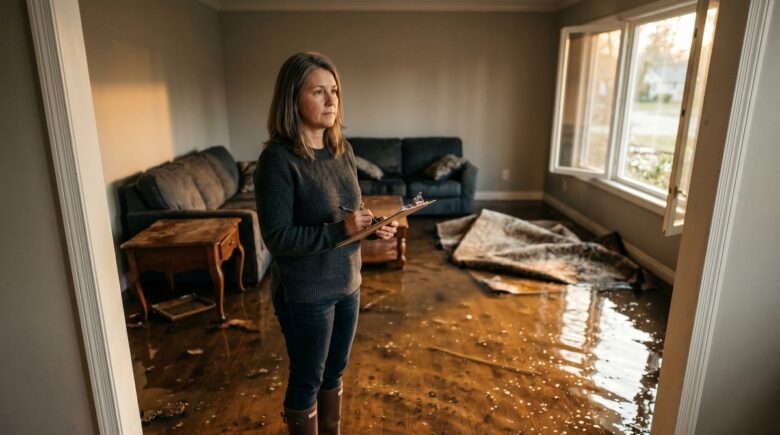
Fact-checked by the The Insurance Scout editorial team
Quick Answer
Understanding flood vs homeowners insurance is essential for any homeowner: standard homeowners policies cover sudden water damage from burst pipes or roof leaks but exclude all flooding. Flood coverage requires a separate policy, typically through FEMA’s National Flood Insurance Program (NFIP). As of July 2025, the average NFIP policy costs $786 per year. To be fully protected, you need both policies.
When it comes to flood vs homeowners insurance, the single most important fact is this: your standard homeowners policy will not pay a single dollar for flood damage. In June 2025, FEMA reported that just one inch of floodwater can cause more than $25,000 in property damage — yet roughly 40% of flood claims come from properties outside high-risk flood zones, where many homeowners falsely assume they have no flood exposure.
Why does this distinction matter right now? Extreme weather events are intensifying across the U.S., and the insurance industry is struggling to keep pace. Several major carriers have exited high-risk states entirely, leaving homeowners scrambling to piece together adequate coverage. Understanding exactly what each policy covers — and where the dangerous gaps are — has never been more urgent.
This guide is for homeowners, first-time buyers, and renters who want a clear, no-jargon breakdown of what water damage is actually covered, how to get flood insurance, what it costs, and how to avoid the costly mistake of assuming you are already covered. By the end, you will know precisely what to do to protect your home.
Key Takeaways
- Standard homeowners insurance does not cover flood damage of any kind — not even an inch of water from an overflowing river, according to the Insurance Information Institute.
- The average NFIP flood insurance policy costs $786 per year, but private flood policies can run higher or lower depending on location and coverage limits, per FEMA’s 2025 program data.
- Homeowners insurance does cover sudden, accidental water damage such as burst pipes — with the average water damage claim reaching $11,098, according to Insurance Information Institute data.
- FEMA’s NFIP provides up to $250,000 in building coverage and up to $100,000 in contents coverage for residential properties, per FEMA’s official coverage limits.
- There is a standard 30-day waiting period before NFIP flood coverage takes effect, so purchasing a policy the week before a storm will not help, as noted by FEMA’s NFIP guidelines.
- Homes in FEMA-designated Special Flood Hazard Areas (SFHAs) with federally backed mortgages are legally required to carry flood insurance under the Flood Disaster Protection Act.
In This Guide
- Step 1: What Does Homeowners Insurance Actually Cover for Water Damage?
- Step 2: What Does Flood Insurance Cover That Homeowners Insurance Doesn’t?
- Step 3: How Do Flood vs Homeowners Insurance Compare Side by Side?
- Step 4: Do I Need Flood Insurance If I’m Not in a Flood Zone?
- Step 5: How Do I Get Flood Insurance and What Does It Cost?
- Step 6: What Water Damage Falls Into a Coverage Gray Area?
- Frequently Asked Questions
Step 1: What Does Homeowners Insurance Actually Cover for Water Damage?
Homeowners insurance covers water damage that is sudden, accidental, and internal in origin — but it draws a hard line at any water that enters your home from the outside. Knowing this distinction upfront tells you exactly which policy to file a claim with after any water event.
What Is Covered
A standard HO-3 homeowners policy — the most common form in the U.S. — typically covers the following water damage scenarios:
- A burst or frozen pipe that suddenly ruptures
- Water damage from a washing machine or dishwasher malfunction
- An accidental overflow from a bathtub or sink
- Water damage from firefighters extinguishing a blaze at your home
- Rain or snow entering through a damaged roof or window caused by a covered peril (such as wind)
The average homeowners insurance claim for water damage and freezing is $11,098, according to Insurance Information Institute claims data. This makes water damage one of the most frequently filed — and most expensive — homeowners claims.
What to Watch Out For
The word “sudden” is load-bearing in your policy. If an adjuster determines that a pipe leak was slow and ongoing — meaning you knew or should have known about it — your insurer can deny the claim as maintenance neglect. Always repair minor leaks promptly and document the repairs. To understand other common reasons claims get denied, read our breakdown of homeowners insurance mistakes that lead to denied claims.
Sewer backup and sump pump overflow are NOT covered by a standard homeowners policy. You must purchase a separate water backup endorsement — typically $50 to $250 per year — to add this protection. Do not assume it is included.
Step 2: What Does Flood Insurance Cover That Homeowners Insurance Doesn’t?
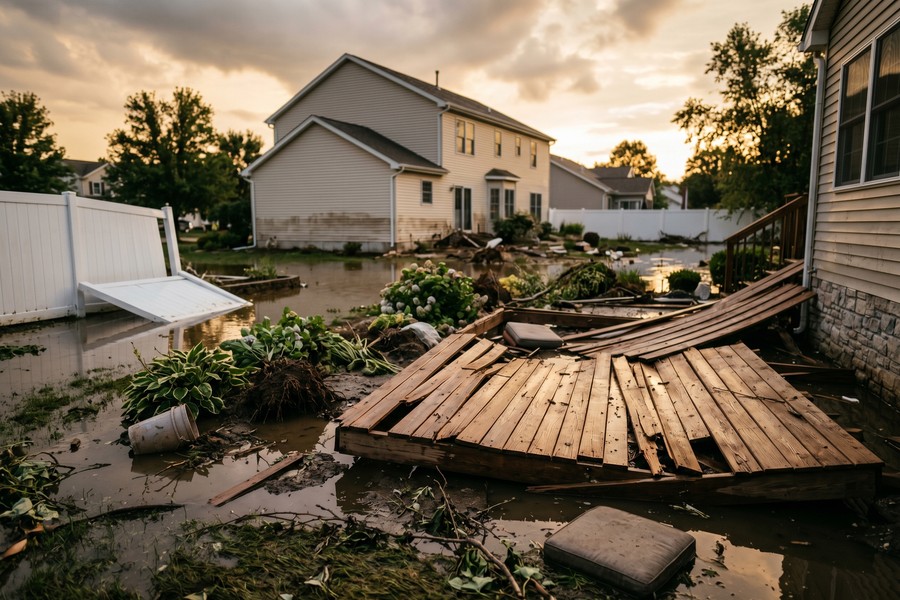
Flood insurance covers damage caused by water that overflows onto normally dry land from an external source — and this is completely excluded from every standard homeowners policy. If a river overflows, a storm surge rolls in, or heavy rainfall overwhelms drainage systems, only a separate flood policy will pay your claim.
How Flood Is Legally Defined
FEMA defines a flood as a general and temporary condition where two or more acres — or two or more properties — experience surface water overflow, mudflow, or rapid accumulation of runoff. This definition matters because it determines whether your insurer classifies an event as flood damage (not covered by homeowners) or internal water damage (potentially covered).
FEMA’s National Flood Insurance Program (NFIP) provides two types of coverage for residential policies:
- Building Property Coverage: Up to $250,000 for the structure itself, including electrical systems, plumbing, HVAC, and built-in appliances.
- Personal Property Coverage: Up to $100,000 for contents such as clothing, furniture, and electronics.
These limits are set by FEMA’s NFIP policy coverage guidelines. If your home is worth more than $250,000, you will need a private flood insurance policy to cover the gap.
What Flood Insurance Does NOT Cover
Even a flood policy has exclusions. The NFIP will not cover:
- Temporary housing or additional living expenses while repairs are made
- Landscaping, decks, patios, fences, and swimming pools
- Cash, precious metals, or valuable papers
- Cars and other self-propelled vehicles (auto insurance handles those)
- Basements contents beyond certain appliances (sump pumps, furnaces, water heaters)
The NFIP has been the primary provider of flood insurance in the U.S. since 1968, but a growing private market now offers higher limits, shorter waiting periods, and broader coverage terms. In 2025, private flood insurance accounted for an increasing share of the market as NFIP rates have risen under the Risk Rating 2.0 pricing model.
Step 3: How Do Flood vs Homeowners Insurance Compare Side by Side?
The clearest way to resolve the flood vs homeowners insurance question is to compare both policies across the scenarios that matter most. The table below does exactly that — with specific coverage limits and no vague “varies” answers.
| Coverage Category | Homeowners Insurance (HO-3) | Flood Insurance (NFIP) |
|---|---|---|
| Burst pipe (internal) | Covered — up to dwelling limit | Not covered |
| River overflow / storm surge | Not covered | Covered — up to $250,000 |
| Heavy rainfall flooding | Not covered | Covered — up to $250,000 |
| Sewer backup | Covered only with endorsement (~$50–$250/yr) | Not covered (unless caused by flood) |
| Personal property / contents | Covered — typically 50–70% of dwelling limit | Covered — up to $100,000 (separate policy) |
| Additional living expenses | Covered — typically 20–30% of dwelling limit | Not covered under NFIP |
| Basement flooding (groundwater) | Not covered | Limited — appliances/systems only |
| Average annual premium | $1,428/year (national avg, 2025) | $786/year (NFIP avg, 2025) |
| Waiting period | Typically immediate | 30 days (NFIP standard) |
| Required by lender? | Yes — for most mortgages | Yes — in FEMA high-risk zones with federal loan |
The national average homeowners insurance premium of $1,428 per year comes from our 2026 homeowners insurance cost breakdown by state, which shows dramatic variation by location. Florida and Louisiana homeowners pay far above the national average due to flood and hurricane exposure.
When shopping for homeowners insurance, always ask your agent to quote a water backup endorsement at the same time. Adding it rarely costs more than $200 per year and closes a gap that standard policies and flood policies both leave open: sewer and drain backups.
Step 4: Do I Need Flood Insurance If I’m Not in a Flood Zone?
Yes — you should strongly consider flood insurance even if you live outside a FEMA-designated high-risk flood zone. About 25% of NFIP flood claims come from properties in low-to-moderate risk areas, according to FEMA’s NFIP program statistics.
How to Check Your Flood Risk
FEMA’s Flood Map Service Center lets you enter any U.S. address to see your official flood zone designation. Properties in Zone A or Zone V are in high-risk Special Flood Hazard Areas (SFHAs) and face a 26% chance of flooding over a 30-year mortgage — far higher than the chance of a fire. Zones B, C, and X are lower risk, but not zero risk.
Flood zone maps are also frequently outdated. FEMA updates them on a rolling basis, and many properties are in unmapped or under-mapped areas where flood risk has grown due to development, deforestation, or climate shifts.
What to Watch Out For
Being outside a high-risk zone means flood insurance is not federally required, but it does not mean flooding cannot happen. Urban flooding — caused by overwhelmed storm drains during heavy rain — can occur in any zip code. If you are weighing the cost, remember that properties in moderate-risk zones are eligible for lower-cost Preferred Risk Policies (PRPs) through the NFIP.
FEMA estimates that just 1 inch of floodwater causes an average of $25,000 in property damage. For most homeowners, one flood event would exceed the cost of a decade’s worth of flood insurance premiums.
“Flood is the number one natural disaster in the United States, and it can happen anywhere it rains. The single biggest misconception we see is homeowners assuming their homeowners policy has them covered when the water comes from outside the home. It does not.”
Step 5: How Do I Get Flood Insurance and What Does It Cost?
You can buy flood insurance through two channels: the federal NFIP (sold through private insurers as “Write Your Own” policies) or directly from a private flood insurance company. The process is straightforward, but there are cost factors and timing rules you need to understand before purchasing.
How to Purchase NFIP Coverage
NFIP policies are available through most major insurance carriers — including Allstate, State Farm, and Farmers — under the Write Your Own (WYO) program. You do not buy directly from FEMA. Contact your existing homeowners insurer first, as bundling with the same agent simplifies claims management. You can also find participating insurers on the FEMA insurer locator page.
What Flood Insurance Costs in 2025
Under FEMA’s Risk Rating 2.0 pricing model — launched in 2021 — premiums are now calculated using individual property characteristics rather than just flood zone maps. Key cost factors include:
- Distance to the nearest water source
- Foundation type (slab, crawlspace, or basement)
- First-floor elevation relative to flood base elevation
- Cost to rebuild the structure
The national average NFIP premium is $786 per year for combined building and contents coverage, per FEMA’s 2025 program data. However, high-risk coastal properties can exceed $3,000 to $5,000 per year. Private flood insurance may offer more competitive rates for some property profiles — get quotes from both channels before deciding.
The 30-Day Waiting Period
This is one of the most critical facts in the entire flood vs homeowners insurance discussion: NFIP policies have a mandatory 30-day waiting period before coverage takes effect. There are narrow exceptions — such as purchasing at the time of a home closing or in response to a lender requirement. But buying a policy because a hurricane is in the forecast will not help you. Plan ahead.
If you are buying a home, this is one of many insurance steps to coordinate before closing. Our guide on homeowners insurance for first-time buyers covers the full insurance checklist you should complete before your closing date.
If your home’s value exceeds the NFIP’s $250,000 building limit, ask private insurers for an excess flood policy to cover the difference. Companies such as Zurich, Lloyd’s of London syndicates, and Neptune Flood offer private flood policies with higher limits and sometimes shorter waiting periods than the NFIP.

Step 6: What Water Damage Falls Into a Coverage Gray Area?
Several water damage scenarios sit in a murky middle ground between flood coverage and homeowners coverage — and these gray areas are where the most claim disputes and coverage gaps occur. Knowing them in advance prevents a devastating surprise after a loss.
Scenario 1: Rain Enters Through a Damaged Roof
If wind — a covered peril — damages your roof and rain enters through the opening, your homeowners policy typically pays. But if your roof was already deteriorated and rain simply leaked through, the insurer may classify it as maintenance neglect and deny the claim. The distinction hinges on whether the entry point was caused by a covered event.
Scenario 2: Groundwater Seepage
Water that seeps through basement walls or up through a concrete floor due to saturated soil is neither covered by homeowners insurance (not sudden/accidental) nor by NFIP flood insurance (does not meet the legal definition of flood). This is one of the most common — and least understood — coverage gaps. A water backup endorsement does not cover it either. Some private flood policies do cover groundwater seepage, so review policy language carefully.
Scenario 3: Overflow From a Neighbor’s Property
If your neighbor’s blocked drain or broken irrigation system sends water onto your property, it could be classified as flood by your insurer — and therefore excluded from your homeowners policy. You may need to pursue the claim against your neighbor’s liability coverage or rely on your flood policy.
“The gray area between flood and homeowners coverage is where we see the most litigation and the most heartbreak. Homeowners need to read their policies carefully — specifically the water damage exclusion language — and not wait until they have a claim to understand what it says.”
Understanding coverage ambiguity also matters when you renovate your home. Finishing a basement, adding a bathroom, or changing your drainage can all affect how a future water claim is evaluated. See our article on how a home renovation affects your homeowners insurance for what to disclose to your insurer.
What to Watch Out For
Always request the adjuster’s written determination of what caused the water damage and which policy section they are applying. If a claim is denied as “flood” by your homeowners insurer and also denied as “not meeting the flood definition” by your flood insurer, you have grounds to dispute both decisions. Document everything with time-stamped photos immediately after any water event.
Coverage decisions also hinge on whether you selected actual cash value or replacement cost coverage on your homeowners policy — a distinction that can mean tens of thousands of dollars at claim time. Our guide on actual cash value vs replacement cost coverage explains exactly which option is worth the extra premium.
The term “water damage” appears in both your homeowners policy (as a covered peril) and as an exclusion (for flood). Insurers sometimes apply the exclusion broadly. If your claim is denied, cite the specific policy language and request a written denial letter — this is your starting point for an appeal or a complaint to your state insurance commissioner.

Frequently Asked Questions
Does homeowners insurance cover flooding from heavy rain?
No — homeowners insurance does not cover flooding caused by heavy rain that enters from outside your home. If rainwater overwhelms drainage systems and enters through doors, windows, or the ground, that is classified as flood damage and requires a separate flood insurance policy. Only rain that enters through a sudden opening caused by a covered peril (like wind) may be covered by homeowners insurance.
What is the difference between flood insurance and homeowners insurance for a basement?
Homeowners insurance may cover sudden water damage in a basement, such as a burst pipe, but excludes flooding. NFIP flood insurance covers basements in a limited way — it pays for essential systems like furnaces, water heaters, sump pumps, and electrical equipment, but does not cover finished walls, flooring, or personal belongings stored in the basement. This is one of the most significant gaps in standard NFIP coverage.
Am I required to have flood insurance if I am not in a flood zone?
You are not legally required to carry flood insurance unless your property is in a FEMA-designated Special Flood Hazard Area (SFHA) and you have a federally backed mortgage. However, FEMA data shows that roughly 25% of flood claims come from properties outside high-risk zones. Flood insurance is optional but strongly advisable for most homeowners, regardless of zone designation.
How long does it take for flood insurance to kick in after I buy it?
NFIP flood insurance has a standard 30-day waiting period before coverage is effective. There are limited exceptions: if you purchase at mortgage closing, if your lender requires it due to a map revision, or if you renew an existing NFIP policy without a lapse. Private flood insurers sometimes offer shorter waiting periods — some as short as 10 to 14 days — which is one reason to compare both options.
Can I get flood insurance through my regular homeowners insurance company?
Yes — most major homeowners insurance carriers, including State Farm, Allstate, and Farmers, sell NFIP flood policies through the Write Your Own (WYO) program. Your existing insurer is often the easiest starting point. You can also purchase private flood insurance directly from specialty carriers like Neptune Flood or Wright Flood, which may offer broader terms or higher limits than the NFIP.
What happens if my home floods and I only have homeowners insurance?
If your home is damaged by flood and you only have homeowners insurance, your claim will be denied. You would be responsible for 100% of the repair costs out of pocket, which FEMA estimates can easily exceed $25,000 for just one inch of water. Without flood insurance, you may qualify for FEMA disaster assistance grants — but these are typically limited to a few thousand dollars and require a presidential disaster declaration for your area.
Is flood insurance worth it if I live in a low-risk area?
For most homeowners in low-to-moderate risk zones, flood insurance is worth the cost. NFIP Preferred Risk Policies (PRPs) for lower-risk properties can cost as little as $100 to $400 per year, according to FEMA program data. Given that a single flood event averages tens of thousands of dollars in damage, the math typically favors carrying coverage — especially as climate patterns shift and flood risk expands to previously unaffected areas.
Does flood insurance cover my car if it gets flooded?
No — neither NFIP flood insurance nor homeowners insurance covers vehicles. Your car is covered for flood damage only if you have comprehensive auto insurance as part of your auto policy. Comprehensive coverage pays for non-collision damage, including flooding, hail, and falling objects. If you only carry liability coverage on your vehicle, flood damage to your car will not be covered.
Should I get flood insurance or homeowners insurance first when buying a home?
You need to secure homeowners insurance before or at closing — lenders require it. If your property is in a FEMA high-risk flood zone, flood insurance must also be in place at closing. If you are in a moderate or low-risk zone, homeowners insurance alone satisfies the lender, but you should purchase flood coverage within 30 days of closing (to avoid any gap if your zone designation changes). Coordinate both policies simultaneously for the simplest setup. Also review named perils vs open perils coverage to understand how your homeowners policy is structured.
How do I file a flood insurance claim after my home floods?
Contact your flood insurance provider — not your homeowners insurer — immediately after flood damage occurs. Document all damage with photos and video before removing any water or debris. Your insurer will assign a claims adjuster, who must inspect the property. Under NFIP rules, you must file a Proof of Loss within 60 days of the flood event. Keep all receipts for emergency repairs, as these may be reimbursable. Avoid making permanent repairs until the adjuster has completed the inspection.
Sources
- FEMA — National Flood Insurance Program Overview
- FEMA NFIP — Policy and Coverage Details
- FEMA — Mandatory Purchase of Flood Insurance
- FEMA Flood Map Service Center — Address Lookup Tool
- Insurance Information Institute — Background on Flood Insurance
- Insurance Information Institute — Homeowners Insurance Facts and Statistics
- FEMA — Find an NFIP Insurance Provider
- Consumer Financial Protection Bureau — What Is Flood Insurance?
- National Association of Insurance Commissioners — Flood Insurance Topic Overview
- The Insurance Scout — Homeowners Insurance Cost 2026: State-by-State Breakdown